Motorcycle Shipping Cost Calculator
Estimate motorcycle shipping cost by distance, open or enclosed transport, and service level. Compare a carrier quote against a transparent planning range.

Use this house repiping cost calculator to estimate a planning range before you contact a plumbing contractor. Enter your home size, pipe material, number of stories, foundation type, and fixture count. The tool estimates a standard interior domestic water-supply repipe. Not sure if you need one yet? See the warning signs below, then run the numbers.
ESTIMATED REPIPE COST
Planning estimate only — excludes the exterior water main, sewer/gas lines, and drywall repair. See full scope details below. Get an in-home inspection before budgeting firmly.
Do you need to repipe?
Several warning signs point to repiping rather than a one-off repair. Low water pressure, discolored or rusty water, frequent pinhole leaks in different spots, and unusually high water bills all suggest the system is failing broadly, not just at one point. Visible corrosion on exposed pipes is another common sign. Catching these signs early can prevent a small leak from turning into a costly water-damage repair later.
A single burst pipe can often be repaired in place. Repeated leaks in different locations usually mean the whole system is nearing the end of its service life, especially in a home with older galvanized steel, polybutylene, or Kitec piping. Repiping the full system avoids paying for repair after repair on pipes that keep failing.
Water pressure that drops gradually in the shower or at a sink often points to internal pipe corrosion narrowing the flow, most common in galvanized steel pipe. A plumber can confirm the cause with a pressure test before you commit to a full repipe.
How it is calculated
The house repiping cost calculator starts with a blended installed rate. This rate combines pipe material, fittings, and typical labor. It is not the price of bare pipe alone. The calculator then adjusts the estimate for the number of stories, foundation access, and fixtures beyond the first ten.
The result appears as a range rather than a single number because every home has a different plumbing layout. Pipe routes, wall access, local labor, permit requirements, and restoration work can change the final price substantially.
Subtotal = Home square footage × blended installed rate.
Adjusted subtotal = Subtotal × story multiplier × foundation multiplier.
Estimated total = Adjusted subtotal + fixture add-on + base labor and permit allowance.
Estimated range = Estimated total × 0.85 to Estimated total × 1.15.
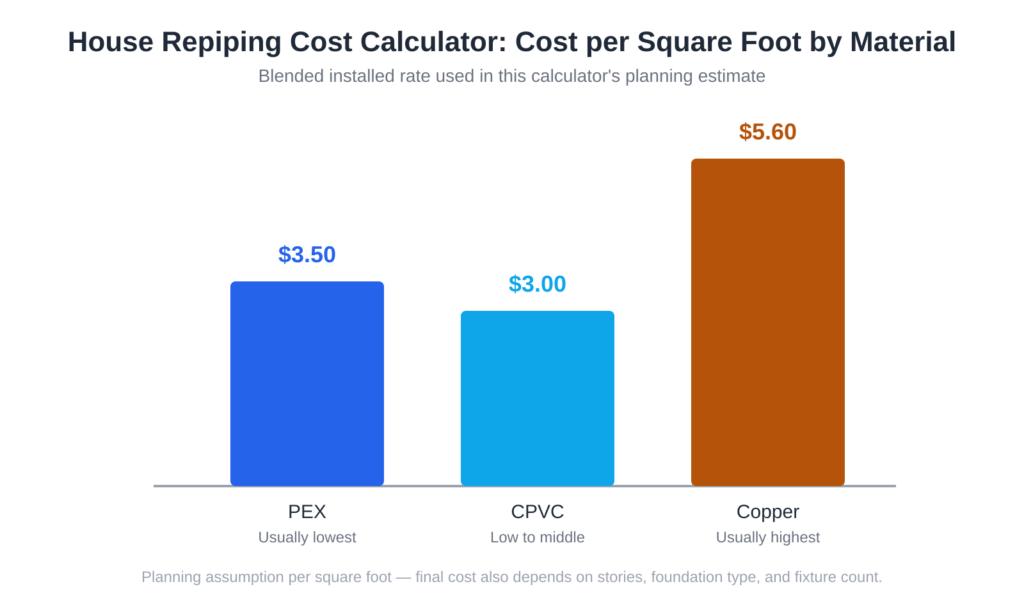
The planning assumptions are PEX at $3.50 per square foot, CPVC at $3.00 per square foot, and copper at $5.60 per square foot. The story multiplier is 1.00 for one story, 1.10 for two stories, and 1.20 for three or more stories. Crawlspace or basement access uses a 1.00 multiplier. Slab access uses a 1.25 multiplier. The first ten fixtures are included. Each additional fixture adds $120. The base labor and permit allowance is $800.
Consider a one-story, 1,500-square-foot home with PEX piping, crawlspace access, and eight to ten fixtures. That combination generally produces a mid-range planning estimate in this calculator. Use the result to prepare questions for a licensed plumber. Do not treat it as a fixed project budget before an in-home inspection.
Cost factors
The cost to repipe a house varies with home size, layout, pipe material, fixture count, access conditions, and local labor rates. Many whole-house interior water-supply projects fall in the mid-thousands, though prices run lower or higher in a given city. A published range is useful for planning. It is not a substitute for a written scope and inspection.
Square footage affects the length of the supply runs. Fixture count affects the number of connection points. Foundation type affects how easily the plumber can reach the existing lines. Labor is often the largest part of the invoice, which is why two similar homes can receive different repipe estimates in nearby markets.
For planning purposes, many homes fall between $4,500 and $11,000 for an interior domestic water-supply repipe. The actual cost depends on location, home size, pipe material, access, restoration, and the condition of the existing plumbing. Ask each contractor to explain the assumptions behind their estimate rather than comparing headline numbers alone.
Material comparison
| Material | Relative cost | Planning notes |
|---|---|---|
| PEX | Usually lowest | Flexible, requires fewer fittings in many layouts, and may reduce wall access. |
| CPVC | Usually low to middle | Rigid routing can make access and layout more important. |
| Copper | Usually highest | Material, tools, labor, and finished-space access can increase the total. |
PEX is often the lower-cost option for a whole-house repipe. It is flexible and may require less cutting in some layouts. Copper commonly costs more because its material, fittings, tools, and installation methods differ. CPVC may sit between PEX and copper. The price depends on the region and the availability of qualified installers.
Price is not the only consideration. Before selecting a material, confirm the local plumbing code and product availability. Also discuss water conditions, warranty terms, expected service life, connection method, and access requirements with a licensed plumbing professional.
This house repiping cost calculator supports three materials, and PEX and copper are the two homeowners compare most often. PEX generally costs less to install. It also resists freeze-related bursts better than rigid copper, since it can expand slightly under pressure. Copper costs more. It has a longer track record, though, and can add resale appeal in some markets. If you are comparing PEX types, PEX-A is more flexible and more freeze-resistant than PEX-B. PEX-B costs slightly less, though, and remains a common, code-approved choice in most areas.
For most homes, PEX repiping falls at the lower end of this calculator’s estimated range, since PEX is the lowest-cost material option among the three the calculator supports. A typical 1,500 square foot, one-story home with crawlspace access and PEX piping generally lands near the lower half of the displayed range. Select PEX in the calculator above to see how it compares to CPVC and copper for your specific home.
Copper produces the highest estimate of the three materials this calculator supports, since it carries the highest blended installed rate. Homeowners often choose copper for its long service life and resale appeal despite the higher upfront cost. Select Copper in the calculator above to compare it directly against PEX and CPVC for your home’s size and layout.
This house repiping cost calculator uses a higher rate for copper partly because of its longevity. Copper pipe typically lasts 50 years or longer under normal water conditions. That long lifespan is one reason it remains popular despite the higher installed cost. Corrosive water, either very acidic or very soft, can shorten that lifespan. A water test is worth doing before choosing copper if your area has unusual water chemistry.
Older pipe materials
Several older pipe materials commonly push homeowners toward a full repipe rather than a partial repair. Each one fails differently, but the underlying decision is usually the same: patching one section leaves the rest of an aging or recalled system in place.
Polybutylene, common in homes built or replumbed between the 1970s and 1990s, degrades from the inside and can rupture without warning, even when the pipe shows no visible damage. The material was the subject of a large class-action settlement in the 1990s. Many insurance companies will not renew a homeowner’s policy until a documented repipe plan is in place. The failure is unpredictable, not localized. Most plumbers recommend a full repipe over patching individual sections.
Galvanized steel, typically found in homes built before the 1960s, corrodes internally over decades, gradually narrowing the pipe and reducing water pressure. Rust-colored water is a common early sign. As with polybutylene, the remaining pipe keeps degrading regardless of which section fails first, so most plumbers recommend replacing the whole system rather than repairing it section by section.
Kitec is a plastic-and-aluminum composite pipe. Installers used it mainly from 1995 to 2007. The maker discontinued it after widespread reports of internal corrosion and fitting failure. It was also the subject of a large class-action settlement. Many insurers treat it the same way they treat polybutylene: a material that calls for a full repipe, not a spot repair. If your home was built or replumbed in that window, ask your plumber to check for Kitec fittings. Look for the brand name or a distinctive orange or blue coating.
Lead supply pipes appear mainly in homes built before the 1950s. They are a health priority because lead can leach into drinking water over time. See the EPA’s guidance on lead in drinking water for how lead enters household plumbing and what steps to take if it is present. Many cities offer partial funding or require disclosure once they find a lead service line. A full interior repipe removes lead supply piping inside the home. The exterior lead service line, if present, is a separate project. It is usually coordinated with the local water utility.
This calculator’s estimate applies once repiping begins. Removing existing galvanized, polybutylene, Kitec, or lead pipe is part of a standard repipe scope, though a plumber may adjust labor if the old pipe is brittle or difficult to access.
Access and project scope
A slab foundation can raise the price when supply lines run below concrete. Cutting, removing, and restoring concrete adds labor and repair work. Some contractors avoid the concrete entirely by rerouting new lines through an attic or interior wall cavities. The chosen route changes the labor mix and restoration scope.
The slab adjustment in this house repiping cost calculator is a simplified allowance. It is not a fixed 25% surcharge for every slab home. Limited access can add cost on top of the foundation type alone. Examples include a tight crawlspace, a finished basement, or a multi-story layout. A single slab leak is a different repair than a full repipe. Fixing one leak usually costs far less than replacing the whole system. Repeated slab leaks, though, often mean the whole system needs replacing, not patching. Ask the plumber which route they plan to use and why it fits the property.
This tool estimates an interior domestic water-supply repipe. The planning scope may include standard fixture connections, typical fittings, ordinary routing, and a general permit allowance.
The estimate does not normally include:
Severely corroded pipes, existing water damage, blocked wall cavities, vaulted ceilings, tile, and cabinets can also increase the final bill. See the section above on polybutylene, galvanized steel, Kitec, and lead pipe if any apply to your home, and review the full scope with a licensed plumber before relying on the estimate.
Planning the project
Many standard homes can be repiped in one to three days. Slab foundations, multi-story layouts, high fixture counts, difficult access, and extensive restoration can extend the schedule. Water service may be shut off in stages, and some crews use temporary connections when the layout allows it.
Ask the contractor how long each part of the home will be without water. Confirm whether permits and inspections are included. Ask how the crew will handle pressure testing, patching, and cleanup.
Ask for a detailed written scope before you approve a whole-house replumbing project. Ask which fixtures the plumber will include and which pipe specification they will install. Also ask whether the design uses a home-run manifold or a trunk-and-branch layout.
Confirm whether the quoted price covers permits, inspections, pressure testing, shutoff valves, and water-heater connections. It should also explain drywall access, patching, painting, cleanup, disposal, and warranty service. A clear scope makes quotes comparable and reduces surprise add-on charges.
For a project this size, get two or three written in-home assessments from licensed contractors. Compare the scope, warranty, material specification, access plan, and restoration allowance. The lowest headline number is not always the lowest total cost.
Ready to move forward? Use the estimate above to prepare for your first repiping quote. Bring the assumptions on this page, including material, square footage, stories, and fixture count, so each contractor’s quote lines up against the same baseline.
For general site information, review the calculator disclaimer. If you have a question about this tool or want to suggest another calculator, use the Contact Us page.
Common questions
The house repiping cost calculator shows many homes falling between $4,500 and $11,000 for an interior water-supply repipe. The actual figure depends on location, home size, pipe material, fixture count, access, permits, and restoration. Only a local inspection can produce a reliable quote.
In this house repiping cost calculator, PEX is often less expensive than copper for both material and installation. The difference depends on the layout, local labor rates, pipe specification, and how much wall or ceiling access the job requires.
PEX generally produces the lowest estimate of the three materials this calculator supports. Select PEX above and compare it against CPVC and copper for your home’s square footage, stories, and fixture count.
Copper generally produces the highest estimate of the three materials this calculator supports, reflecting its higher material and labor cost compared to PEX or CPVC. Select Copper above to see the estimate for your home’s specific size and layout.
PEX resists freeze damage better than rigid copper or CPVC because it can expand slightly under pressure. It can still freeze and burst in extreme, prolonged cold. Insulating exposed runs in unheated spaces is still worth doing, regardless of material.
No. A slab can make access harder, but the planned route determines much of the price. An attic or overhead route may cost less than removing large areas of concrete. Ask the contractor to explain the access plan.
All four typically call for a full repipe rather than a partial repair, since the remaining old pipe keeps degrading regardless of which section fails first. Kitec and polybutylene are also common insurance and resale concerns even before a leak occurs. See the section above for how each material affects the project.
Standard homeowners insurance usually covers sudden, accidental damage, such as water damage from a burst pipe, but not the cost of replacing old or deteriorating pipes themselves. Some insurers require a repipe before renewing coverage on a home with known polybutylene, Kitec, or galvanized steel piping. Check your policy or ask your insurance agent directly.
No. The tool covers interior water-supply piping and typical fixture connections. Drywall, tile, paint, flooring, and major concrete restoration are usually excluded. A contractor may include them only if it is in writing.
Not always. A partial repipe can address the most damaged or inaccessible runs first. The trade-off is that older sections remain in service and may need future repairs. Ask a licensed plumber to compare a partial and complete repipe over the long term.
This is a planning tool, not a bid. The final quote can differ after a plumber inspects the property, covering the pipe route, wall access, foundation, existing damage, permits, and restoration requirements.
Data and methodology
The calculator uses planning assumptions for blended installed rates, story multipliers, foundation access, fixture allowances, and a base labor and permit allowance. These assumptions were benchmarked against public contractor and home-service cost references. Sources include Angi’s house repiping cost guide, Repipe Solutions, and CPI Service. We then checked the assumptions against practical repipe scenarios.
These sources reflect regional contractor pricing rather than a single national survey. Treat the result as a national planning guide, not a local quote. Material prices, labor rates, permit fees, and restoration costs can change. We review the assumptions when market conditions shift.
This house repiping cost calculator is for planning only. Obtain an in-home inspection and at least two written quotes before committing to a repiping project.
Reviewed August 2026. Cost figures are planning assumptions and are not a guarantee of local contractor pricing.
Keep exploring
Estimate motorcycle shipping cost by distance, open or enclosed transport, and service level. Compare a carrier quote against a transparent planning range.
Estimate aluminum fence cost per linear foot with local material and labor rates, height, style, gates, pool barrier notes, and removal, then compare a contractor quote against a transparent planning total.
Convert X/12, rise and run, degrees, or slope percent into pitch, angle, multiplier, and optional rafter length. Free roof pitch chart and transparent math.
Estimate IAAI / IAA buyer fees, bid fees, and total cost to get the car home from a winning bid, with reverse budget and optional storage and transport.
Estimate vinyl fence cost per linear foot with local material and labor rates, height, style, gates, and removal, then compare a contractor quote against a transparent planning total.
Estimate privacy fence cost per linear foot for 4, 6, and 8-foot runs with local material and labor rates, gates, and removal, then compare a contractor quote.
Estimate wood fence cost per linear foot with local material and labor rates, height, style, gates, and removal, then compare a contractor quote against a transparent planning total.
Estimate chain link fence cost per linear foot with local material and labor rates, height, gates, and removal, then compare a contractor quote.
Estimate fence cost per linear foot with local material and labor rates, height, gates, and removal, then compare a contractor quote against a transparent planning total.
Estimate soffit and fascia cost per linear foot with local material and labor rates, optional drip edge and gutters, then compare a contractor quote against a transparent planning total.
Estimate roof replacement cost from multi-section measurements and local material and labor rates, then compare a contractor quote against a transparent planning total.
Work out what a Copart winning bid really costs: buyer fee, gate fee, virtual bid fee and the total, plus fees as a percentage of your bid.
Price a furnace and AC replacement by home size, efficiency and ductwork, then check whether the system size you were quoted actually fits.
Estimate stump grinding cost per diameter inch by stump size, species, grind depth and access, then check a contractor quote.
Estimate a land clearing planning range from acreage, vegetation, terrain, access, debris and stumps, then compare a contractor quote.
Estimate siding coverage from walls, gables and openings, then compare a Hardie siding project scope using local rates you enter.
A roof square footage calculator turns length, width, and pitch into sloped roof area and roofing squares. First, enter your measurements below. Then read the result in square feet and in squares (100 sq ft = 1 roofing square). In addition, this tool handles up to eight sections when a garage, porch, or dormer needs … Read more
Every new calculator starts from a real question someone searched for. Tell us yours.
Suggest a tool →