
Roof Replacement Cost Calculator
A typical roof replacement with architectural asphalt shingles costs roughly $9,000 to $18,000 for a 2,000 to 2,300 sq ft roof footprint. See the size-based ranges further down for other roof sizes. Even so, the real number depends on roof size, material, pitch, tear-off layers, and local labor rates. This roof replacement cost calculator turns those inputs into a planning total you control — no invented national averages locked inside the tool.
Roof Replacement Cost Calculator
This calculator estimates what a new roof may cost once you enter the size of the roof, the material you want, and the rates a contractor or supplier has given you. It keeps measurement, waste, tear-off, labor, and add-ons visible rather than hiding them behind one blended figure.
Whether you call it a roofing calculator, a roof calculator, a roof cost estimator, a roof estimate calculator, or a new roof cost calculator, the useful first step is the same. Measure the roof surface, state the assumptions, and compare like-for-like scope. You may also search for a roof square footage calculator or metal roof cost calculator. The measurement logic is shared; the cost lines are what you add.
How this tool is built. The calculator follows the standard pitch-factor formula for geometry. It prices material on the rounded purchase quantity (whole roofing squares). It prices labor and tear-off on net installed area. Rates stay blank until you enter them. Suggested starter values for common materials are editable, and they exist only to give you a place to begin. Key Calculators does not invent local market prices.
Unlike simple single-box tools, this calculator handles up to six roof sections. Each section carries its own length, width, pitch, and measurement basis (wall-line, roof-edge, or measured sloped area). That matters on cut-up roofs, where one average pitch would understate the surface.
How the roof replacement cost calculator works
The calculator runs in three steps. First, it turns your roof dimensions and pitch into net sloped area and order quantity. Second, it applies the rates you supply for material, labor, and tear-off. Third, it shows a planning total you can set next to a written contractor quote or roof replacement estimate.
The tool prices material on the rounded purchase quantity. It prices labor and tear-off on net installed area. That split matches how most residential jobs are actually billed.
What the numbers mean
- Net sloped area — the actual surface after pitch is applied.
- Order area — net area plus overage and waste.
- Purchase squares — order area rounded up to whole roofing squares (1 square = 100 sq ft).
- Planning total — the sum of every rate and add-on you entered.
What affects the cost to replace a roof
Five things drive the cost of roof replacement more than anything else. They are the size of the roof surface, the material you choose, the steepness and complexity of the roof, the number of existing layers to tear off, and the labor rate in your market.
A 2,000 sq ft footprint is not a 2,000 sq ft roof. Pitch adds surface. A common 6/12 pitch increases area by roughly 12 percent. So a 2,000 sq ft footprint at 6/12 carries about 2,236 sq ft of roof surface before waste. Steeper roofs and cut-up layouts with hips and valleys raise both material quantity and labor time.
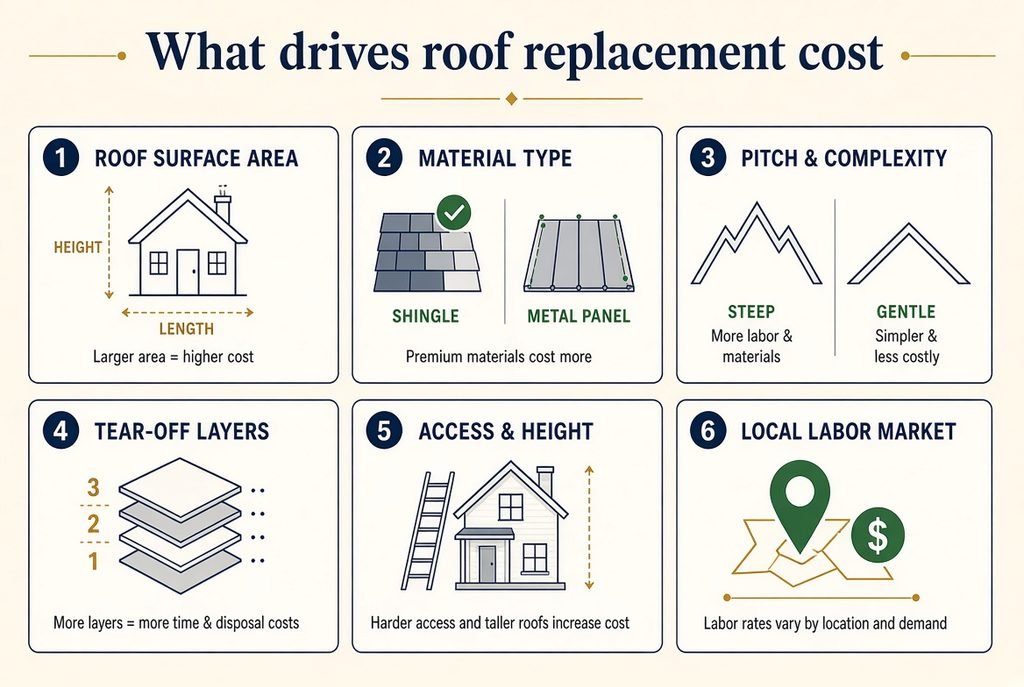
Cost drivers at a glance
| Driver | How it moves the total |
|---|---|
| Roof surface area | More squares = more material and labor |
| Material type | 3-tab asphalt sits at the low end; standing seam and slate sit at the high end |
| Pitch and complexity | Steeper or cut-up roofs need more labor and often more waste |
| Tear-off layers | Each existing layer adds removal and disposal cost |
| Access and height | Two-story work, limited driveway access, or staging raises labor |
| Local labor market | The same scope can differ by thousands of dollars between regions |
National averages published online often disagree by a wide margin. That happens because they measure different things — different home sizes, different materials, different regions, and different survey methods. The calculator avoids that problem by letting you enter the rates that apply to your job.
What adds to the base cost
Beyond material and labor, common add-ons include ridge vent or ridge cap, drip edge, ice-and-water shield in cold climates, chimney and skylight flashing, and gutter work if the existing system ties into the roof edge. The calculator has fields for deck repair, permits, and access, so those line items stay visible instead of disappearing into a single blended number.
Deck repair and site work sometimes overlap with land clearing, where the same scope-control logic applies. Both jobs reward a firm boundary between what is included and what is not.
Average roof replacement cost by roof size
The cost to replace roof surfaces scales with the size of the roof itself, not the footprint of the house underneath it. That is why the cost of a new roof can differ sharply between two homes with the same floor plan once pitch is added in. The table below gives an average roof replacement cost range for architectural shingles, the most common residential material, at a typical 6/12 pitch. It answers the general question of how much does a roof cost for common home sizes. It is not a substitute for the calculator above.

| House footprint | Roof area at 6/12 pitch | Average roof replacement cost (architectural shingles) |
|---|---|---|
| 1,200 sq ft | ~1,340 sq ft | $5,400 – $9,400 |
| 1,500 sq ft | ~1,680 sq ft | $6,700 – $11,800 |
| 1,800 sq ft | ~2,010 sq ft | $8,000 – $14,100 |
| 2,000 sq ft | ~2,240 sq ft | $9,000 – $15,700 |
| 2,500 sq ft | ~2,800 sq ft | $11,200 – $19,600 |
| 3,000 sq ft | ~3,350 sq ft | $13,400 – $23,450 |
These ranges use the same $4.00–$7.00 per square foot installed band for architectural shingles shown later. They apply that band to roof area rather than house footprint. They exclude tear-off, deck repair, permits, and access. Add those separately for a full roof replacement estimate. The cost of a new roof for your own home still depends on the material, pitch, tear-off, and labor rates you enter above.
Enter your own footprint, pitch, and material above to turn this roof calculator into a precise new roof cost calculator for your job. Or use it simply as a quick roof estimate calculator before you call a contractor.
Roofing cost per square and per square foot
Roofing is priced by the square. One roofing square equals 100 square feet of roof surface. Contractors usually quote installed cost per square; suppliers quote material per square or per bundle. Whether your quote uses roofing cost per square foot or cost per square, this calculator reports both so you can compare either way.
Roofing cost per square: what contractors actually quote
As a planning range, architectural shingles often land around $550 to $800 per square installed. Meanwhile, 3-tab shingles sit closer to $450 to $650 per square. Those figures blend material and labor; tear-off and access sit on top. Once you know how many squares the roof needs, the planning total follows from the rates you enter. The calculator reports both cost per square foot and cost per square, so you can read either form of quote. Both figures come from the same net-area total, so cost per square is simply cost per square foot multiplied by 100.
Tear-off cost and labor cost per square
Tear-off cost is billed separately from material in this calculator. That is because removing and disposing of an old roof is priced by the square foot of net area, not by the material going back on. A single layer of asphalt is usually straightforward. However, multiple layers, embedded fasteners, or a steep pitch add labor time and dump-fee cost quickly. That is why tear-off gets its own line instead of being folded into a material rate.
Like stump grinding, tear-off is priced by what has to be removed and disposed of, not by what goes back on afterward. Roofing labor cost per square is the other figure worth separating out. The installed ranges in the material table below already blend material and labor together. If your contractor or supplier quotes them separately, enter the labor rate on its own. The calculator applies it to net installed area — the same basis most contractors use when they bid a job.
Material options and typical planning ranges
Material choice is usually the largest single lever on total cost. The ranges below are planning examples only. They are not locked into the calculator. Enter the rates your supplier or contractor has given you.
| Material | Typical installed range (planning only) | Notes |
|---|---|---|
| 3-tab asphalt shingles | $3.50 – $5.50 / sq ft | Lowest installed cost; shorter service life |
| Architectural shingles | $4.00 – $7.00 / sq ft | Most common residential choice |
| Luxury / designer shingles | $6.00 – $10.00 / sq ft | Heavier, longer warranty options |
| Corrugated / exposed-fastener metal | $7.00 – $12.00 / sq ft | Faster install than standing seam |
| Standing seam metal | $10.00 – $18.00 / sq ft | Premium look and weather tightness |
| Concrete or clay tile | $10.00 – $22.00 / sq ft | Heavy; structure must support the load |
| Cedar shake | $8.00 – $14.00 / sq ft | Requires maintenance in wet climates |
| TPO / EPDM (low-slope) | $5.00 – $9.00 / sq ft | Common on flat and low-slope roofs |
These figures combine material and labor in rough national bands. Your market may sit higher or lower. Tear-off, deck repair, permits, and access sit on top of the material-and-labor base.
Asphalt roof replacement cost
Asphalt roof replacement cost remains the volume choice for most single-family homes. Two reasons drive that: the installed price per square is lower, and the labor pool is larger. Architectural shingles are the usual specification. 3-tab sits lower on price and service life, while luxury laminates sit higher on both.
Metal roof cost
Metal roof cost sits well above architectural asphalt on most jobs. Material price and specialized labor drive most of the gap. If you are comparing the two, run the same roof size and waste factor through the calculator twice. Set an asphalt rate once, then set a metal rate. That way the only variable that changes is the material line.
Standing seam metal roof cost typically runs from about $10 to $18 per square foot installed. That range reflects the concealed-fastener panels, factory finishes, and specialized crews the system requires. That premium buys a longer service life and stronger wind and snow performance than exposed-fastener panels. It is usually why standing seam gets compared against premium asphalt or tile rather than against 3-tab shingles.
Pitch, waste, and how roof area is measured
A roof square footage calculator has to convert flat footprint into sloped surface. The standard pitch multiplier is:
Pitch factor = √(1 + (rise ÷ run)²)
At 6/12 the factor is about 1.118. At 12/12 it is about 1.414. The calculator applies that factor to each section you enter.

Pitch factor reference
| Pitch | Factor | 1,000 sq ft footprint becomes |
|---|---|---|
| 3/12 | 1.031 | 1,031 sq ft |
| 4/12 | 1.054 | 1,054 sq ft |
| 5/12 | 1.083 | 1,083 sq ft |
| 6/12 | 1.118 | 1,118 sq ft |
| 8/12 | 1.202 | 1,202 sq ft |
| 10/12 | 1.302 | 1,302 sq ft |
| 12/12 | 1.414 | 1,414 sq ft |
How much waste should you add?
Waste covers cuts at hips, valleys, rakes, and penetrations, plus the overlap built into each course. Under-ordering is expensive. A second delivery often arrives from a different production lot and can show a color mismatch.
- 10% — simple rectangular gable with few penetrations
- 15% — typical residential re-roof (default)
- 20% — multiple valleys, steep pitch, or complex layout
- 25% — very complex or historic geometry
The calculator lets you set overage and waste separately, so measurement uncertainty and installation loss stay distinct. A full tear-off and re-roof often sits near the 15% default. Meanwhile, a reroof over a simple gable can sit lower.
Check a contractor quote with the roof replacement cost estimate
Once the planning total is on screen, enter the total from a written proposal in the quote comparison box. The tool shows the dollar difference and the percentage difference. A gap is not automatically a problem. Scope, flashing details, deck repairs, access, and warranty terms often explain it.
Use the comparison as a conversation starter, not as a verdict. Ask the contractor which line items sit outside the assumptions you entered. That is usually more productive than arguing about a single bottom-line number. Quotes we have seen for the same roof size can differ by several thousand dollars once tear-off, access, and flashing are itemized separately.
Roof replacement cost FAQs
How much does a new roof cost?
The cost to replace a roof on a typical 2,000 to 2,300 sq ft footprint with architectural asphalt often lands near $9,000 to $18,000 once material and labor are included, before tear-off and access. Exact cost of a new roof depends on roof size, material, pitch, existing layers, and local labor rates. The calculator turns those inputs into a planning total you control.
What is the average roof replacement cost?
Average roof replacement cost figures online often sit near $9,000 to $18,000 for architectural asphalt on a typical single-family home, but the spread is wide. Averages mix different sizes, materials, regions, and survey methods. Use them as a rough band, then enter your own rates above for a job-specific number.
What is a roofing square?
One roofing square equals 100 square feet of roof surface. Material and installed work are both commonly quoted by the square. Divide total roof area by 100 to get the square count.
How accurate is this roof replacement cost calculator?
It is as accurate as the measurements and rates you enter. Geometry follows standard pitch-factor math. Cost lines use only the numbers you supply. It will not match a final contract if scope, hidden deck damage, or access conditions differ from what you assumed. Figures on this page reflect planning ranges as of 2026.
Why is my quote higher than the roof replacement cost estimate?
Common reasons include extra layers of tear-off, deck repairs, difficult access, custom flashing, higher-grade underlayment, or a busier local labor market. Compare line items, not just the bottom line.
Does the calculator include tear-off?
Yes. You set the number of existing layers and a tear-off rate per square foot. The cost then applies to net area. Leave the rate blank if tear-off is not part of the job. Cost to tear off and replace a roof rises quickly once a second or third layer is present.
Can I use this as a metal roof cost calculator?
Yes. Choose standing seam, corrugated, or metal shingles in the material list and enter the metal rates you have been quoted. The same measurement and waste logic applies.
Is reroofing cheaper than a full replacement?
Sometimes. A reroof that leaves an existing layer in place can save tear-off and disposal cost. However, many jurisdictions limit how many layers are allowed, and many warranties require a clean deck. When a full tear-off is required, the cost to reroof and the cost of a full replacement converge. Enter the layer count above to see the difference on your own numbers.
Is this roof replacement cost a final quote?
No. It is a planning worksheet. Final price comes from a licensed contractor after an on-roof inspection. Use the tool to understand the drivers and to check whether a written proposal is in the same neighborhood as the assumptions you made.
How do I measure roof square footage from the ground?
Measure the building footprint length and width. Add overhangs if you are working from wall lines. Then multiply by the pitch factor for your roof. The calculator does that conversion for each section you enter. Final material orders should still be confirmed from the roof surface by a professional.
What waste factor should I use for a hip roof?
Hip roofs usually need more cutting than simple gables. Fifteen to twenty percent is a common planning range. Complex hips with multiple valleys often sit at the higher end.
Is it cheaper to repair or replace a roof?
A repair usually costs far less upfront than a full replacement. Even so, repeated repairs on a roof near the end of its service life can add up to more than one replacement over time. As a rough guide, widespread damage, a roof already within the last few years of its expected lifespan, or more than one or two prior repairs usually tip the math toward replacement. This calculator is built for replacement planning; it does not price individual repairs.
How long does a roof replacement take?
Most single-family roof replacements take one to three days once the crew starts. The range depends on roof size, pitch, material, and weather. Steep or cut-up roofs, multiple tear-off layers, and materials like tile or standing seam typically add time. Treat the roof replacement estimate here as a planning number for that conversation, and ask your contractor for a scheduled timeline once a written proposal is in hand.
Does insurance cover roof replacement?
Sometimes — typically only when the damage comes from a covered event such as wind, hail, or a fallen tree, not from ordinary wear or age. This calculator does not estimate insurance claims, deductibles, or depreciation holdbacks. If you are filing a claim, get a contractor’s inspection and an adjuster’s scope of work before comparing it to a planning total here.
Related tools and further reading
If you only need the surface area and material quantity without cost rates, use the Roof Square Footage Calculator. That tool shares the same multi-section geometry engine and is the right place to start when you want coverage only. For exterior wall coverage, see the Hardie Siding Cost Calculator. For whole-house plumbing work, see the House Repiping Cost Calculator.
External references worth checking for current product and code information:
- National Roofing Contractors Association
- Asphalt Roofing Manufacturers Association
- Metal Roofing Alliance
Limits and disclaimer
This roof replacement cost calculator is a planning aid. It does not replace a professional takeoff, a written contract, or an on-roof inspection. It does not diagnose structural conditions, select products for code compliance, or calculate contractor overhead and profit. Always verify coverage, accessories, installation requirements, and warranty terms with the manufacturer and a licensed local contractor before you buy or sign.