
Fascia & Soffit Cost Calculator
Most homeowners replacing the eave line spend somewhere in the ballpark of $9 to $34 per linear foot for combined soffit and fascia work. A 150-foot run often lands around $1,350 to $5,100. A 200-foot run can hit $1,800 to $6,800. But those bands only mean something once you know your own material and labor rates. This soffit and fascia cost calculator turns linear footage and the rates you enter into a planning total you control. Nothing is locked to a national average inside the tool.
Maybe you searched for a fascia board replacement cost calculator. Others look up the cost to replace soffit and fascia, a soffit repair cost estimate, or simply need new soffits and fascia priced from scratch. The first step stays the same either way: measure the eave in linear feet, state your assumptions, and compare like-for-like scope on a written quote. Enter your local rates below and you get a per-foot figure that reflects your market — not somebody else’s average.
Fascia & Soffit Cost Calculator
How this tool is built. This soffit and fascia cost calculator prices work per linear foot of run — the same unit most contractors use. You price material on order length (net feet plus waste) and labor on net length. Fields stay blank until you type your own rates. Optional starter suggestions for common materials stay editable so you can begin without locking a national average. Key Calculators does not invent local market prices.
How the soffit and fascia cost calculator works
The calculator runs in three steps. First you enter fascia and soffit linear feet and whether the soffit is solid or vented. Second you enter material and labor rates — plus any optional lines for removal, drip edge, gutters, two-story access, tax, or a minimum job charge. Third you see a planning total you can set next to a written contractor quote.
Order length carries the waste so the material line matches how suppliers bill. Net length carries labor so you are not paying crew time on the waste allowance. Most residential eave jobs price those two lines the same way.
What the numbers mean
- Net linear feet — the measured fascia and soffit runs.
- Order length — net feet plus waste or overage.
- Core cost — material plus labor only.
- All-in cost — core cost plus removal, drip edge, gutters, access, tax, and any minimum-charge adjustment.
- Planning total — the sum of every rate and add-on you entered.
Cost to replace soffit and fascia
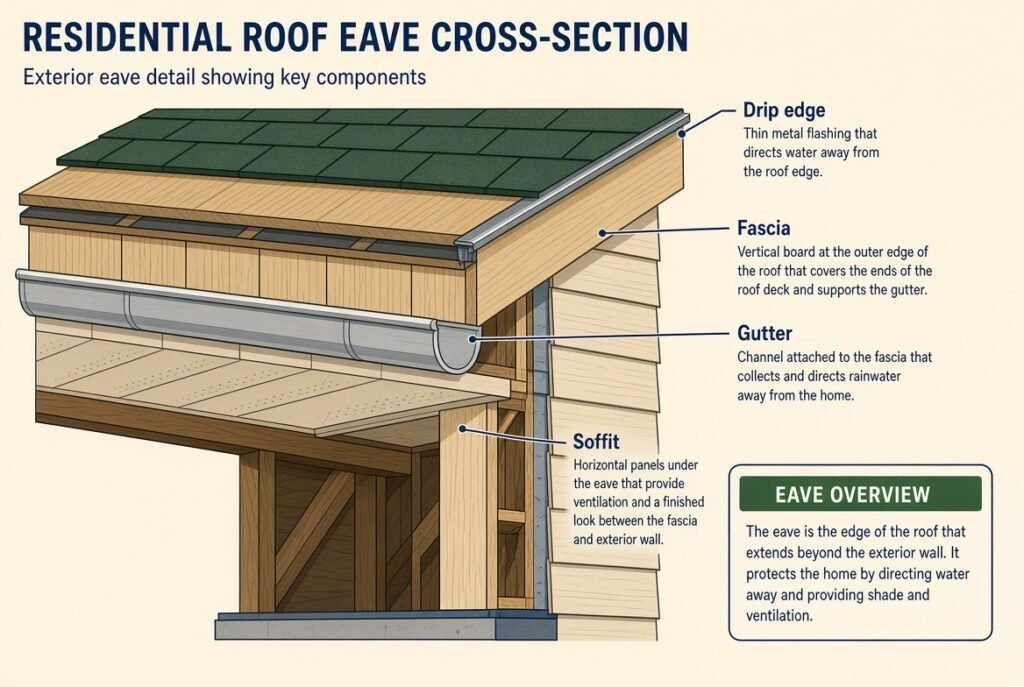
Length, material, tear-off, and local labor drive the cost to replace soffit and fascia — and the related soffit and fascia replacement cost. A full eave replacement on a single-story home with vinyl or aluminum often falls in a lower band than wood that needs paint, or fiber cement that needs heavier handling. Two-story access, rotted subfascia, and gutter work push the total higher.
Published cost guides do not agree with each other on this one. Depending on the source and the year, writers quote combined soffit-and-fascia pricing anywhere from about $6 to more than $40 per linear foot. A common current band for a soffit and fascia replacement sits around $9 to $34 per linear foot, or about $900 to $6,800 for a 100 to 200 foot job. Treat every published figure, including this one, as orientation only. Enter the rates on your written quotes in the calculator above so the planning total matches your market.
Cost to install soffit and fascia
New construction or a clean soffit and fascia installation without heavy tear-off usually costs less per foot than a full replacement of failed wood. Material choice, eave complexity, and whether the soffit is vented still shape the cost to install soffit and fascia. On multi-story work, labor often takes a large share of the total because staging slows the crew.
Already have material and labor rates from a supplier or contractor? Put them in the Rates step. The tool applies material to order length and labor to net length so you can see how each line contributes to the fascia and soffit installation cost.
Labor cost to install soffit and fascia
Most crews quote labor cost to install soffit and fascia per linear foot of eave, not as a flat day rate — though some will bid a job total after measuring. On simple single-story runs, labor may sit in a modest band relative to material. Two-story access, tight landscaping, or removing failed wood raises the labor line. Enter the labor rate from your proposal in the calculator; the tool applies it to net linear feet only, not to the waste allowance.
Fascia board replacement cost
Contractors usually quote fascia board replacement cost per linear foot. The cost to install fascia board follows the same logic when there is no old board to remove — a clean install without tear-off usually costs less. A fascia board installation cost quote should say plainly whether removal is included. Wood often posts the lowest material line but needs ongoing paint and tends to rot where gutters leak. Vinyl, aluminum, composite, and fiber cement trade higher material cost for lower maintenance.
Labor for fascia alone is usually lower than a combined soffit-and-fascia package only when the soffit is left in place and still sound. Use the fascia linear-feet field on its own if you are only replacing the board that carries the gutter. Leave soffit feet at zero when that work is not in scope. If you are shopping a cost to replace fascia board number, this is the cleanest field to isolate it.
Labor cost to replace fascia board
Bidders most often bury the labor cost to replace fascia board inside a blended quote. On a single-story eave with straightforward access, fascia labor usually takes the smaller share of the total. On two-story homes, steep roofs, or jobs with rotted subfascia and rafter tails, labor can overtake material. Ask each bidder for labor and material broken out per linear foot so you can compare apples to apples.
Soffit and fascia cost per linear foot
When every bidder uses the same measured length, soffit and fascia cost per linear foot gives you the cleanest quote comparison. Ask for material and labor broken out per foot, then enter those rates in the calculator. A blended job total without a length makes it hard to see whether a gap is material, labor, removal, or add-ons.
Inside the tool, core cost per linear foot is material plus labor only. All-in cost per linear foot includes removal, drip edge, gutters, access, tax, and any minimum charge. That split keeps a large gutter line from looking like an expensive fascia rate.
Planning ranges by eave length
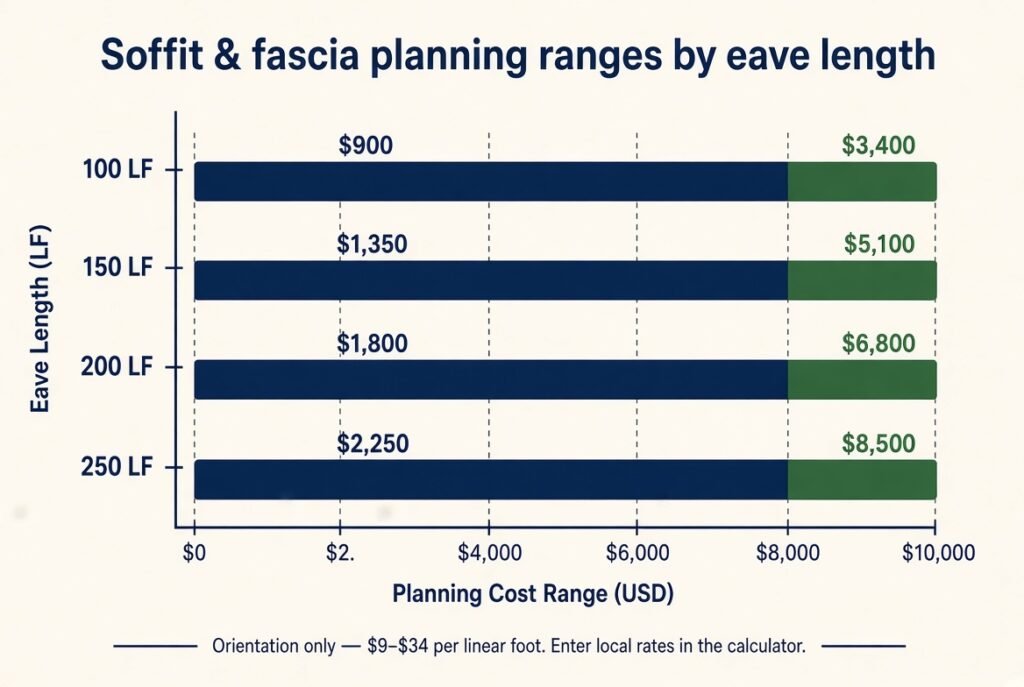
The table below is a planning orientation only, not a quote. It multiplies eave length by the same $9-to-$34 combined band described above for illustration. Use the soffit and fascia cost calculator above with your own rates for a total that matches your job.
| Eave length (LF) | Planning range (combined soffit + fascia) |
|---|---|
| 100 | $900 – $3,400 |
| 150 | $1,350 – $5,100 |
| 200 | $1,800 – $6,800 |
| 250 | $2,250 – $8,500 |
The low end of each row reflects a simpler material and access profile; the high end reflects premium products, harder access, or more removal. Steep two-story work and structural repair sit outside these orientation bands. Always verify with local written quotes.
Soffit and fascia repair vs. replacement
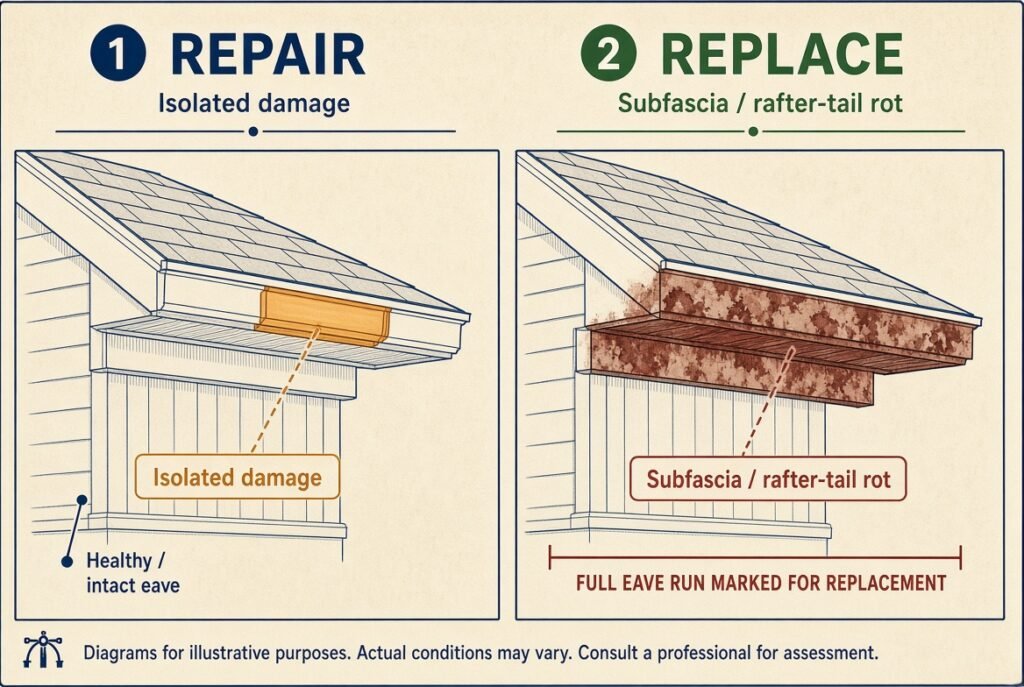
When damage covers only a short section, a targeted repair often costs less than replacing the full eave run. Patching a few feet of vented vinyl or swapping one fascia board can run a few hundred dollars. Once moisture reaches the subfascia or rafter tails, or staining and failed paint cover most of the eave, full replacement is usually the cleaner long-term choice.
Soffit repair cost
How much panel is damaged — and whether the fascia must come off for access — sets the soffit repair cost. Small panel swaps on a reachable single-story eave stay at the low end. Widespread failure, pest damage, or the need to open the fascia and check framing pushes the job toward a full soffit and fascia replacement cost instead of repeated patches.
Soft wood under a screwdriver tip, staining from chronic gutter overflow, insect activity in the eave, and boards already patched more than once all favor replacement over repeated repair. Use the calculator to plan a measured install or replacement; it does not diagnose structural conditions.
What if there is rot behind the fascia?
Rot behind the fascia — in the subfascia or at the rafter tails — often shows up as a cost surprise after removal starts. A rotted fascia board repair cost can climb quickly once framing is involved. Budget a contingency line or a higher removal rate when the existing wood is soft, the gutters have leaked for years, or previous repairs look incomplete. Ask a contractor for an on-site inspection before new fascia goes up if you need to confirm framing work.
Vinyl, aluminum, wood, and other fascia and soffit materials
Material choice changes both the installed cost and the maintenance you take on afterward. The calculator’s material selector can pre-fill editable starter rates; treat those as planning aids only. Swap them for the numbers on your supplier sheet or contractor proposal. Sections below cover the most common soffit material and fascia board options.
Vinyl soffit and fascia
Vinyl soffit is a common budget-friendly option, and vinyl fascia covers are widely available for simple eave lines. Vinyl needs no paint, handles moisture better than unfinished wood, and installs relatively quickly on straightforward eaves. Color choices stay limited compared with painted wood, and cheap vinyl can turn brittle in extreme cold.
Aluminum soffit and fascia
Aluminum soffit and aluminum fascia stay durable, light, and widely used on both new builds and replacements. Aluminum resists rot and insects and often ships pre-finished. Installed cost per linear foot usually sits above basic vinyl and below many premium composites. Ladders or storms that leave dents are the main long-term complaint.
Wood, composite, PVC, and fiber cement fascia
Wood fascia remains common where you want a painted trim look — note that searchers sometimes misspell it facia board, but the correct term is fascia. Material cost can look low on paper, but paint cycles and rot risk raise lifetime cost. Composite fascia and PVC fascia cut maintenance and hold paint well. Fiber cement fascia and metal fascia trade heavier material and handling for long service life. Enter the rate that matches the product you intend to buy.
Soffit vs fascia — what is the difference?
Fascia is the vertical board along the roof edge that often supports the gutter. Soffit is the underside of the eave between the fascia and the wall. A vented soffit supports attic intake airflow when paired with adequate exhaust ventilation; a solid soffit does not. Most full eave jobs touch both, which is why the tool prices them together but lets you isolate either one.
Drip edge and gutters on the same job
Roof drip edge flashing sits at the roof edge and directs water into the gutter or off the eave. Crews often replace drip edge flashing when fascia comes off because they pull the old metal with the boards. Use the optional drip edge linear feet and rate fields so that line stays visible instead of disappearing into a blended total.
Crews often replace or rehang gutters when fascia comes off, because the gutter hangs from or against the fascia board. When your quote includes new gutters, enter gutter length and rate as an add-on. Leave those fields blank when gutters are a separate contract so the soffit and fascia plan stays clean.
Need roof work on the same project? Measure the roof surface first with the roof square footage calculator, then come back here to plan the eave budget.
DIY vs. hiring a pro for fascia and soffit
Fascia and soffit work looks simple from the ground and rarely is. Ladders, staging, and roof-edge work carry real fall risk, and you must install the trim so water sheds the way the product manufacturer intends. That said, a confident DIYer on a single-story eave can sometimes handle a small repair. For a full replacement — especially on a two-story home — a licensed contractor is usually the safer and faster path.
Planning to replace soffit without removing fascia? Check the product instructions first. Some vinyl systems allow it; many crews still pull the fascia to access the soffit cleanly and reinstall both as a package.
Cost to paint soffit and fascia
Painting is a separate scope from replacement. Prep, height, and the existing finish set the cost to paint soffit and fascia. Painting to delay replacement? Budget for it as a short-term fix — paint does not stop rot once the wood is soft. This calculator does not price painting; the note is here so you know that line is not included in the planning total.
Check a contractor quote against your soffit and fascia cost plan
Once you have a planning total from the soffit and fascia cost calculator, paste the contractor’s written total into the quote field. The tool shows how much higher or lower the quote sits relative to your plan. A gap is not automatically a problem — rot repair, two-story access, or a better material can explain it — but you should be able to walk through it line by line.
Ask for the same scope you modeled: linear feet of fascia, linear feet of soffit, material product, removal, drip edge, and gutters if included. Comparing a full eave replacement to a patch repair is not a fair check.
Soffit and fascia cost calculator FAQs
How do you calculate soffit and fascia cost?
Measure the eave in linear feet for fascia and for soffit, multiply by the material and labor rates that apply, add waste on the material side, then add removal, drip edge, gutters, access, and tax if those are in scope. The calculator above follows that sequence and keeps every line visible.
How much does soffit and fascia cost per linear foot?
Depending on material, access, and region, combined installed work often falls in the $9 to $34 per linear foot range, though published guides vary more widely than that. Your local quotes matter more than any published band. Enter those rates in the tool for a job-specific per-foot figure.
Is labor included in soffit and fascia cost?
It depends on the quote. Some proposals blend material and labor into one per-foot number. Others list them apart. This calculator keeps labor as its own rate on net linear feet so you can see the split.
How much does it cost to replace 100 linear feet of soffit and fascia?
Using the same orientation rates as the table above, 100 linear feet of combined work often falls somewhere between about $900 and $3,400 before unusual access or structural repair. Enter 100 in the length fields that match your eave and your local rates for a tighter number.
What is the difference between soffit and fascia?
Fascia is the vertical board along the roof edge that often supports the gutter. Soffit is the underside of the eave between the fascia and the wall. Vented soffit supports attic intake airflow when the roof also has adequate exhaust ventilation; solid soffit does not provide that intake path.
How much does it cost to repair rotted fascia board?
Small repairs can run a few hundred dollars when only a short run of board is involved. Once rot reaches the subfascia or rafter tails, costs climb because crews add framing repair to the trim work. Inspect before you budget a simple board swap.
Can you replace soffit without removing fascia?
Sometimes — especially with flexible vinyl systems — but the approach is often awkward and risks damaging the fascia. Many crews remove fascia to access the soffit cleanly and reinstall both as a package. Follow the product instructions and the contractor’s method for your material.
Is drip edge included in fascia replacement?
Not always. Some quotes include new drip edge; others list it separately or reuse existing metal. If drip edge is part of your job, enter its length and rate as an optional line so it does not hide inside a blended fascia number.
How accurate is this soffit and fascia cost calculator?
Accuracy tracks the quality of your inputs. When linear feet and rates match a written scope, the planning total gives you a fair baseline for comparison. It is not a final quote. Sign only to a contractor’s written proposal after they measure the eave, check substrate condition, and confirm product and access.
Related calculators
If you need the roof surface area first, start with the roof square footage calculator. To plan a full roof budget, use the roof replacement cost calculator. To price fiber cement walls, see the Hardie siding cost calculator.
External resources
For additional cost context, see HomeGuide’s soffit and fascia repair cost guide and Angi’s fascia and soffit repair cost breakdown.
Limits and disclaimer
This soffit and fascia cost calculator is a planning aid. It does not replace a professional takeoff, a written contract, or an on-site inspection. It does not diagnose structural rot, select products for code compliance, or calculate contractor overhead and profit. Always verify coverage, accessories, installation requirements, and warranty terms with the manufacturer and a licensed local contractor before you buy or sign.