
Copart Fee Calculator [Buyer Fee & Total Cost Estimator 2026]
Use this Copart fee calculator to work out what a winning bid actually costs once every charge lands. Enter your bid, title type, payment method and how you won the lot — pre-bid, live, or Buy It Now — and the copart calculator itemizes every fee, then shows the number almost nobody leads with: fees as a percentage of your bid.
Copart Fee Calculator
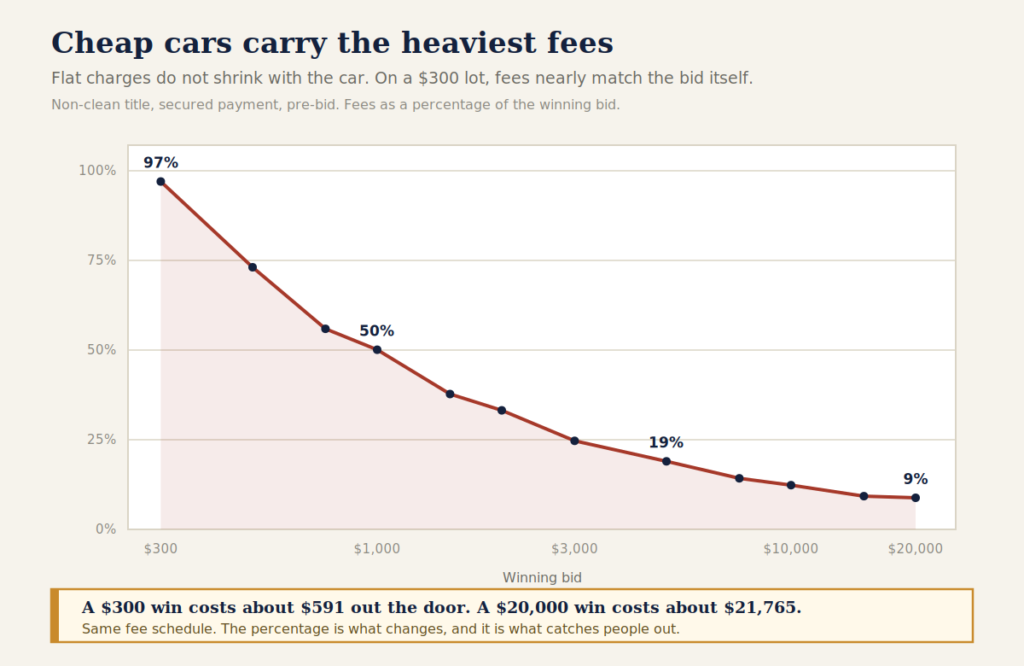
That percentage is the whole story. On Copart’s own published schedule, a $20,000 clean-title car works out to about 8.44% in fees. Drop to a $300 non-clean lot and fees run to roughly $302–$305 — more than the bid itself. Same fee schedule, two completely different experiences, and it’s why a lot of first-time bidders feel stung after their first invoice.
How Much Are Copart Fees? [2026 Copart Fees Chart]
On a typical winning bid, expect a buyer fee that runs from $25 up to a straight percentage of the bid above $15,000, plus a $79–$95 gate fee, a $15 environmental fee, $15–$20 in title mailing, and a virtual bid fee of up to $149. Add sales tax, transport, and any conditional charges, and the true cost of a car sits well above the hammer price.
The buyer fee is the one that moves. Everything else is close to flat, which is why fees land around 8% on a $20,000 clean-title purchase and can exceed 100% of the bid on a $300 salvage lot. The copart fee calculator above shows both the dollar total and that percentage side by side, so you see the real shape of the deal before you commit.
Why Are Copart Fees So High on Cheap Lots?
Because most of the schedule is flat. The gate fee, environmental fee and title mailing don’t care what you bid — a $79 gate fee is the same whether the car sold for $300 or $30,000. On a $20,000 car those flat charges barely register. On a $300 car they’re most of the invoice, and the percentage-of-bid figure the copart calculator shows is exactly where that shows up.
What Fees Does This Copart Fee Calculator Include?
Nine charges can land on a Copart invoice, and this calculator computes every one of them: the buyer fee, virtual bid fee, gate fee, environmental fee, title mailing, storage, late payment, vehicle relist, and 3rd-party finance. By far the largest and most variable is the buyer fee. The rest are flat or nearly flat. Here’s the current schedule this tool is built on.
Copart Buyer Fee [Bracket Table by Title & Payment Type]
The buyer fee sits on a bracket table up to $15,000, then switches to a flat percentage of the bid. Which numbers apply depends on four things: your title type (clean or non-clean), your payment method (secured or unsecured), your vehicle class (standard or heavy), and — for licensed accounts — your buying volume. Miss any one of those and your estimate drifts. Reference points from Copart’s own published schedule:
Non-Licensed (Consumer) Buyer Fee — Standard Vehicle
| Final bid price | Clean, secured | Clean, unsecured | Non-clean, secured | Non-clean, unsecured |
|---|---|---|---|---|
| $300–$349.99 | $120.00 | $137.50 | $137.50 | $155.00 |
| $500–$549.99 | $185.00 | $212.50 | $205.00 | $235.00 |
| $1,000–$1,199.99 | $325.00 | $385.00 | $375.00 | $440.00 |
| $2,500–$2,999.99 | $500.00 | $650.00 | $610.00 | $775.00 |
| $5,000–$5,499.99 | $750.00 | $1,000.00 | $775.00 | $1,025.00 |
| $10,000–$10,499.99 | $850.00 | $1,200.00 | $1,000.00 | $1,390.00 |
| $15,000 and up | 7.25% | 12.25% | 7.50% | 12.50% |
Licensed and business accounts see a separate, generally cheaper set of tables, with further tiers based on how many vehicles you buy and spend a year. Those tables aren’t published in the same place as the public schedule above, so if you’re a licensed buyer, use the buyer-fee override field in the calculator and type in the number from your own account rather than trust the public default.
Other Copart Fees at a Glance
Copart Gate Fee
The gate fee covers moving the vehicle from the storage row to the buyer loading area. It’s a flat charge on every purchase. On Copart’s published schedule it’s $79.00 on a clean title and $95.00 on a non-clean title. It isn’t refundable if you change your mind, and it isn’t negotiable.
Copart Virtual Bid Fee
Charged for bidding through a terminal, computer, smartphone, tablet or other bidding device, and tiered by your high bid. Very small lots pay nothing. On a clean title it climbs to a cap of $129 on pre-bid, $149 on a live win; on a non-clean title the caps are $140 pre-bid, $160 live. Buy It Now purchases skip this fee entirely.
Copart Environmental Fee
A flat $15 fee applied to every item sold, covering handling and care in compliance with environmental regulations. It doesn’t change with the bid or the title type.
Copart Title Mailing Fee
Covers sending the title to you or your state’s titling authority: $15 by USPS or $20 by FedEx for multiple titles from a single location, or $20 per title if you pick it up in person. You’ll need Limited Power of Attorney on file for Copart to mail it. This is separate from the sales tax and registration fees your DMV charges later.
Copart Storage Fee
If you don’t collect the vehicle within 3 business days (including the day of sale), storage kicks in. There’s no single flat rate — Copart publishes the daily rate per yard on that yard’s own Locations page, so check yours and enter it in the storage-days field. A week of storage at a busy urban yard can easily cost more than the environmental and title fees combined.
Copart Late Payment Fee
Payment is due within 3 business days including the sale day. Miss it and Copart adds a flat $50 per vehicle, on top of everything else. Let it run further and it becomes a relist.
Copart Vehicle Relist Fee
If the lot isn’t paid in full within 8 calendar days including the sale day, it gets relisted and you’re charged 10% of the final sale price, with a $600 minimum. If you have a deposit on file, Copart takes it straight out of that. It’s by far the most expensive outcome on this page — which is exactly why the payment deadline matters more than any other number here.
Copart 3rd-Party Finance Fee
Buying through a Copart-affiliated finance company adds a $69 flooring service fee. Third-party financing counts as a secured payment method for buyer-fee purposes, so it can still save you money overall even with this added on.
Why Does Every Copart Fee Calculator Give a Different Answer?
Because Copart changes fees without publishing an effective date, and third-party calculators copy each other at different moments. We checked several popular tools while building this one, and they don’t agree — the gaps aren’t small.
Take the gate fee. Some tools say $59. Others say $79 or $95. The likeliest explanation: $79 is the clean-title rate and $95 is non-clean, and single-figure tools just picked one. Virtual bid fees fared worse — we saw figures anywhere from $39 to $160 presented as current, when the real answer depends on title type and whether you bid live or ahead of time.
What This Copart Fee Calculator Does Differently
We built this one directly off Copart’s own published U.S. Non-Licensed fee pages, date it, and then hand you the controls. Every fee has an override field — if your account sits on a different table (licensed, high-volume, heavy vehicle), type your own numbers in and the estimate becomes accurate for you instead of for an average that fits nobody.
There’s also a calibration check. Enter a past winning bid and the total fees from that invoice, and the tool tells you how far our schedule sits from what you actually paid. If it’s off by more than 10%, that’s your signal to use the overrides before trusting anything else on the page.
Copart Member Fees: Licensed vs Non-Licensed
Copart splits buyer fees by whether you’re a licensed dealer/broker or a public, non-licensed member — and separately, by whether you have a business license on file (a Business Member) or not (a Consumer Member). Licensed and business tables are generally cheaper, because those accounts are expected to buy at volume. Public buyers fall under the non-licensed schedule, which is the default this calculator ships with.
Within the licensed side, Copart offers additional fee discounts to high-volume dealers who purchase 25 or more vehicles a year and/or spend $75,000 or more annually with the company — on top of what the standard licensed table already saves versus the public rate. Which tier applies is decided by Copart based on your account history, not something you set yourself, and it can shift year to year. If your account has moved tiers since you last checked, the override fields are how you correct for it here.
Heavy vehicles — industrial equipment, medium and heavy duty trucks, RVs, trailers, agricultural and construction equipment, and buses — are priced on a separate, generally higher schedule than standard cars and trucks, regardless of licensing status.
Secured vs Unsecured Payment: The Expensive Mistake
Paying by an unsecured method isn’t a small surcharge — it moves your entire buyer fee onto a more expensive table. At the top bracket the gap is 7.25% against 12.25% on a clean title (7.50% vs 12.50% non-clean), which is a large jump in fees on the same car.
Worse, it’s all or nothing: pay any part of the invoice with an unsecured method and Copart prices the whole purchase that way. Splitting a wire transfer and a card doesn’t split the fee.
Copart Payment Methods: Secured vs Unsecured
- Secured: wire transfer, cashier’s check, debit card, cash, money order, MoneyGram, ePay, Western Union, company check on a verified account, third-party financing, funds already on deposit in your Copart account.
- Unsecured: credit card, PayPal, Apple Pay, Google Pay, Samsung Pay and other wallet apps.
Wire transfer is the payment method that scales cleanly at large amounts, and it’s the standard route for international buyers. Your bank’s own wire fee sits outside everything on this page, so factor that in separately.
Which Copart Fees Can You Actually Reduce?
Four fees respond to how you behave, and one of those is free to fix. The buyer fee, gate fee and environmental fee are fixed by the schedule — you can’t negotiate them. The rest are within your control.
Bid Ahead Instead of Live
The virtual bid fee is tiered on your high bid, and pre-bidding costs less than winning the same lot live — up to $20 less at the top tier. Setting your maximum in advance is both cheaper and removes the auction-room adrenaline that makes people overbid. Buy It Now purchases skip the virtual bid fee altogether.
Pay With Secured Funds
Covered above, and usually the single biggest saving available on a mid-priced lot — often several hundred dollars at once.
Collect the Car Quickly
Storage starts after 3 business days, and the daily rate varies by yard. Arrange transport before you bid, not after you win.
Pay On Time
The payment window is 3 business days including the sale day. Miss it and you add a flat late fee; let it run to 8 days and you’re facing a relist fee that dwarfs everything else on this page.
Copart Total Cost Calculator: Max Bid From Your Budget
Work backwards, and the answer is usually lower than people guess. The copart fee calculator above has a budget field for exactly this. Enter what you can spend in total, and it finds the highest bid that still lands inside your budget once fees, tax and transport are counted.
The gap surprises most first-time buyers. A $3,000 all-in budget doesn’t buy a $3,000 car — depending on your settings, it buys something closer to $2,300–$2,400, because several hundred dollars disappears into fees before the vehicle has moved an inch.
This is the discipline that separates people who make money at salvage auctions from people who don’t: bid against the invoice total, never against the hammer price.
Planning other big purchases too? Explore our other free tools: the house repiping cost calculator, the roof square footage calculator, and the Hardie siding cost calculator.
Copart Shipping & Delivery Cost [After You Win]
Winning the bid isn’t the end of the cost. Once your fees are settled, you still need to get the car from the Copart yard to your driveway — by pickup, by a hired tow truck, or through Copart’s own delivery service if it’s offered at your yard. None of this is included in the Copart invoice itself, which is exactly why the copart fee calculator keeps transport as a separate line rather than folding it into the total.
Shipping cost depends mainly on distance and whether the vehicle runs. A short local haul with your own trailer might cost nothing but time; a cross-country tow on a non-running salvage vehicle can run into four figures. If Copart’s own delivery option is available for your lot, it’s usually competitive for medium distances, but always compare it against an independent auto transport quote before you bid — the estimate needs to be in your budget field, not an afterthought once you’ve already won.
Do You Need a Copart Broker?
Some states and some lots restrict bidding to licensed dealers, and some inventory is simply easier to reach through a licensed account. If you’re a public buyer trying to access that inventory, a Copart broker bids on your behalf using their license, and their fee stacks on top of everything Copart itself charges — Copart has no control over what a broker charges you.
Before hiring one, weigh the broker’s fee against what you’d actually save on the licensed buyer-fee table versus the public non-licensed table, plus whatever inventory access you’re gaining. For a lot you could already reach as a public member, a broker is pure added cost. For inventory that’s genuinely licensed-only, it may be the only way in — just add their fee to the calculator’s total before you decide your max bid.
Buy It Now vs Bidding: What Changes
Some Copart lots carry a Buy It Now price instead of, or alongside, an auction. Purchasing at that fixed price skips the bidding process entirely — and with it, the virtual bid fee. Everything else on the invoice (buyer fee, gate fee, environmental fee, title mailing) still applies the same way it would on a winning bid of the same amount.
Buy It Now is worth comparing directly against a pre-bid strategy on the same lot: you lose the chance of winning below the listed price, but you gain certainty and skip one fee. Run both numbers through the calculator before deciding which route costs less for your specific lot.
Calculadora Copart en Español [Guía Rápida]
¿Buscas una calculadora Copart en español? Esta herramienta funciona igual sin importar el idioma: ingresa tu oferta ganadora, el tipo de título (limpio o no limpio) y tu método de pago, y calculará la tarifa del comprador, la tarifa de acceso (“gate fee”), la tarifa ambiental, el envío del título y el costo total — usando el mismo calendario de tarifas oficial de Copart descrito arriba. Si compras como miembro no autorizado (sin licencia de distribuidor), este es el calendario que aplica a tu cuenta.
Copart Fee Calculator FAQs
How much are Copart fees on a $1,000 car?
On Copart’s published schedule, a $1,000 clean-title lot paid with secured funds and won by pre-bid carries about $510 in Copart fees — roughly half the bid again. A non-clean lot at the same price runs closer to $575. Your own account may differ, which is what the override fields are for.
How much are Copart fees on a $500 car?
Fees on a $500 non-clean lot land around $385 with secured funds, or about $415 with unsecured payment — because the flat gate, environmental and title charges dominate at this price. This is the trap the percentage-of-bid figure in the calculator is built to make visible.
What is the Copart gate fee?
A flat charge for moving the vehicle from the storage row to the buyer loading area: $79 on a clean title, $95 on a non-clean title. Every purchase carries it, whatever you bid.
What is the Copart virtual bid fee?
A charge for bidding online, tiered by your high bid. It caps at $129 (pre-bid) or $149 (live) on a clean title, and $140/$160 on a non-clean title. Buy It Now purchases avoid it entirely.
Does Copart charge a relist fee?
Yes — if you win a lot and don’t pay within 8 calendar days, Copart relists it and charges 10% of the final sale price with a $600 minimum, deducted from your deposit if you have one on file. It’s the single most expensive mistake a buyer can make.
Is the Copart gate fee refundable?
No. It’s charged on every purchase whether or not you collect the vehicle. Abandon the lot and you still owe the gate fee, plus a possible relist fee on top.
Do I need a broker or a dealer license to buy from Copart?
For most inventory, no — a public, non-licensed membership is enough. Some lots and some states restrict access to licensed dealers, and reaching those means going through a broker whose fee stacks on top of Copart’s own charges.
Does Copart charge sales tax?
Copart’s invoice itself is fee-based, not tax-based — sales tax is generally handled when you register the vehicle with your state, not on the Copart invoice. The calculator keeps your tax rate as a separate field for this reason, so you can see both numbers apart. Rules vary by state, so confirm with your local DMV.
Why is my invoice higher than this Copart fee calculator says?
Most often your account sits on a different fee table (licensed, high-volume, or heavy vehicle), or a conditional charge applied that the estimate didn’t include. Run the calibration check with a past invoice, then enter your real numbers in the override fields.
How long do I have to pay and pick up my vehicle?
Payment is due within 3 business days including the sale day, and storage typically starts after that same window. Both are short enough that arranging funds and transport before you bid is the only sensible approach.
How much does it cost to ship a car from Copart?
It depends on distance and whether the vehicle runs, and it isn’t part of the Copart invoice. Get a quote — from Copart’s own delivery option where offered, or an independent transport company — before you bid, and add it to your total in the calculator’s transport field.
Is this Copart fee calculator official?
No. Key Calculators is not affiliated with Copart, and this isn’t a quote. It’s an independent estimator built on Copart’s published fee schedule, designed to be corrected with your own account numbers. The schedule on your own account always wins.
Copart Fee Calculator: Method, Limits & Sources
The engine applies Copart’s published non-licensed bracket table up to $15,000 and a flat percentage above it, split by title type (clean/non-clean) and payment security (secured/unsecured). On top of that go the tiered virtual bid fee, gate and environmental charges, title mailing, and any conditional charges you select. It reports fees as a percentage of the bid, keeps tax and transport outside the Copart invoice total, and can back-solve a maximum bid from a budget.
The default schedule is taken directly from Copart’s own published U.S. Non-Licensed fee pages, dated September 2026. It’s anchored on a verified worked example: a $20,000 clean-title, secured, pre-bid purchase computes to $1,688 in fees — 7.25% buyer fee plus the $129 virtual bid cap, $79 gate fee, $15 environmental fee and $15 title mailing — and our engine reproduces that figure exactly.
This tool doesn’t access your Copart account, can’t see the fee table applied to your buyer number, doesn’t know your yard’s storage rate, and can’t confirm title status or lot eligibility. Licensed, business and high-volume discount tables aren’t published publicly in the same place as the standard schedule, so those numbers need to come from your own account via the override fields. Treat this as preparation, then verify.
Last reviewed: September 2026, against Copart’s own published U.S. Non-Licensed fee schedule.
- Copart Member Fees — official help center article. The authoritative source for definitions and general fee policy.
- Copart’s own U.S. Non-Licensed Fees schedule pages (clean title and non-clean title), accessed via your Copart account — the authoritative source for your exact bracket numbers.
Trademark notice: Copart and the Copart logo are registered trademarks of Copart, Inc. Key Calculators is not affiliated with, endorsed by, or sponsored by Copart. The name is used here only to describe the auction whose published fees this tool estimates.