
Hardie Siding Cost Calculator | Free & Accurate 2026
This Hardie siding cost calculator estimates siding coverage from walls, triangular gables, doors, and windows, then lets you compare it with local rates you receive. It keeps geometry, waste, trim, removal, tax, and optional costs visible rather than hiding them in one national average.
You may also search for a Hardie board siding cost calculator, HardiePlank cost calculator, fiber cement siding calculator, or siding square calculator. The terms vary, but the useful first step is the same: measure the exterior surfaces, state the assumptions, and compare like-for-like written scope using this Hardie siding cost calculator as your starting point.
Hardie Siding Cost Calculator
Important brand notice: “Hardie” and related product names are trademarks associated with James Hardie Building Products Inc. Key Calculators is not affiliated with, sponsored by, or endorsed by James Hardie. Use the exact coverage, accessory, installation, and warranty information supplied for the specific product you intend to buy.
Start with the exterior surfaces that will receive siding. Then decide which openings should be deducted, enter a waste allowance once, and use supplier or contractor rates rather than assuming a generic online price applies to your home.
Measure rectangular walls and triangular gables separately. Doors and windows can be deducted from coverage when appropriate, while their perimeter can still matter for trim planning.
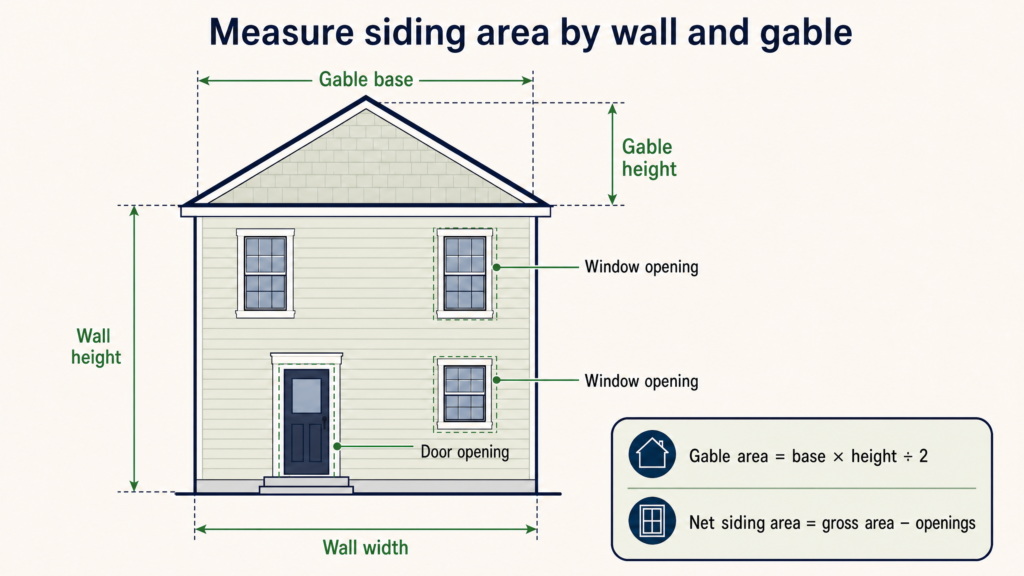
How to Measure Siding Area for the Hardie Siding Cost Calculator?
The calculator begins with exterior area, not interior floor area. Use measured exterior dimensions, building plans, or a professional takeoff; do not climb ladders, roofs, or scaffolding simply to make an online estimate.
For every rectangular wall, measure the width and height in feet and multiply them. A 32 ft wide wall that is 10 ft high has 320 sq ft of gross wall area. For every triangular gable, measure the horizontal width at the base and the vertical height from the base to the peak. Its area is width × height ÷ 2. A 20 ft wide gable that is 8 ft tall adds 80 sq ft, not 160 sq ft.
The worksheet totals walls and gables as gross siding area, then deducts only the openings you choose. Each opening is width × height × quantity. This matches the wall, gable, and opening distinction in Inch Calculator’s siding material guide. An opening cannot exceed gross area; the calculator shows an error rather than forcing an implausible zero.
Whether to deduct an opening is a planning decision, not a universal rule. Cuts and trim can consume material around openings, so the worksheet keeps a visible toggle for each one. An opening’s perimeter can still contribute to optional linear-foot trim planning even when its area is deducted.
Gross Area, Net Area, and Purchase Coverage
| Term | What it means | How this worksheet uses it |
|---|---|---|
| Gross siding area | All measured rectangular walls plus triangular gables. | Shows the full exterior measurement before opening deductions. |
| Opening deductions | Selected door and window areas. | Subtracts only the openings you toggle on. |
| Net siding area | Gross area minus selected opening deductions. | Can be used for removal and, if selected, labor planning. |
| Purchase coverage | Net siding area plus one editable waste allowance. | Used for siding-material coverage and siding squares. |
One siding square equals 100 sq ft of material coverage. The calculator shows a fractional quantity and a whole-square planning figure. Exact boundaries remain exact: 10.00 squares stays 10, not 11. Actual package counts and coverage vary, so product documentation and the supplier order sheet control the final order.
Why the Waste Field Appears Once?
Waste represents additional coverage for cuts, offcuts, breakage, layout, complexity, and measurement uncertainty. The worksheet applies the editable allowance once to net siding area. The 10% starting value is a planning entry, not a recommendation for every product or elevation. Follow the exact siding and trim system instructions before ordering.
How the Hardie Siding Cost Calculator Keeps Costs Transparent?
There is no reliable one-price answer for a Hardie siding project. The manufacturer notes that cost can depend on home size and shape, product line, local labor pricing, removal, conditions behind old siding, permits, location, and scope. James Hardie’s project-planning guidance supports checking what an estimate includes rather than treating a broad range as a project-specific quote.
*(Optional: if you have verified, current regional pricing data — e.g., “material typically runs X–Y per sq ft” and “installed cost typically runs X–Y per sq ft” — insert a short sourced range here. This is the single highest-impact content gap for this keyword; searchers expect at least a ballpark number even on a calculator page. Do not publish a figure you can’t source and date.)*
This Hardie siding cost calculator therefore asks for rates from your supplier, contractor, or written quote. Blank rates stay blank: it does not convert a missing number into a $0 cost. A literal rate of $0 remains valid when intentionally entered. This avoids presenting an incomplete total as a finished budget.
The planning total is a transparent worksheet of the cost lines you enter. It is useful for organizing a conversation, not for replacing a written scope of work.
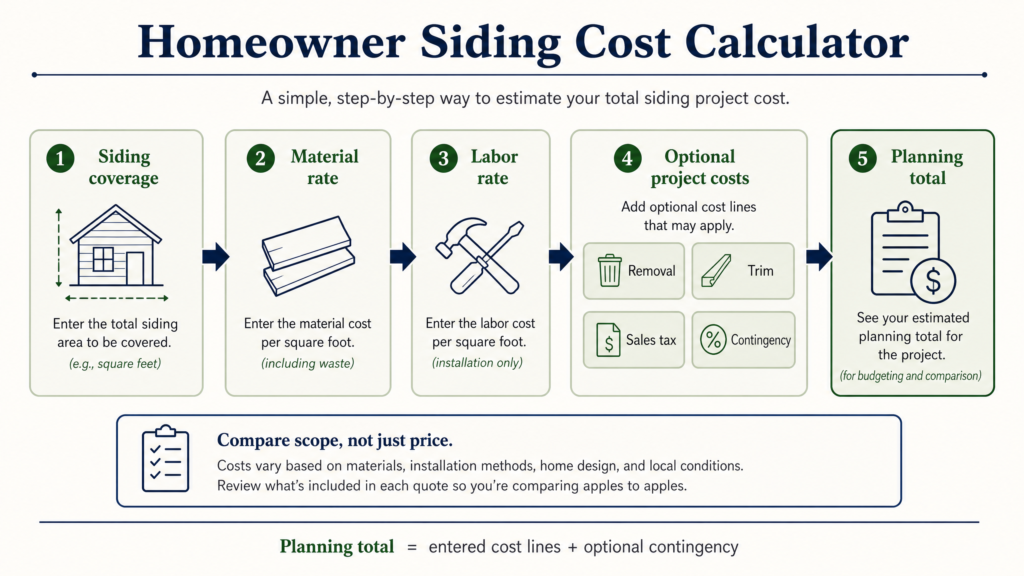
What Each Optional Cost Line Means?
- Siding material — purchase coverage × the material rate you enter per sq ft.
- Labor — net siding area or gross measured area, at your entered rate.
- Removal — net siding area, since removed siding is not purchase waste.
- Trim — opening perimeter, added corner/trim feet, a linear-foot rate, and a flat allowance combined.
- Sales tax — limited to calculated material cost only, since tax treatment and taxable items differ by location and invoice.
- Field paint — available only on a primed basis; intentionally excluded from a prefinished plan.
- Other costs — permits and access costs are separate optional flat lines.
- Contingency — applies only to calculated material, labor, removal, variable trim, and field-paint lines. It does not compound sales tax, flat trim, permits, access, concealed-condition allowances, or the minimum-charge adjustment — preventing one broad percentage from being applied to unrelated costs twice.
Minimum Charges and Site Conditions
Some projects have a minimum mobilization or labor charge. The calculator adds an optional adjustment only when the calculated scope subtotal is lower than that threshold.
The following cannot be determined from exterior measurements and should stay as separate line items reviewed in a written scope:
- Access and staging equipment
- Sheathing repairs
- Water damage or rot
- Flashing work
- Other concealed conditions
How to Use This Hardie Siding Cost Calculator to Check a Contractor Quote?
The best use of this Hardie siding cost calculator is to ask better questions, not to declare that a contractor’s price is right or wrong. Compare the worksheet with the written proposal line by line. A difference may be reasonable when the contractor includes access equipment, detailed trim, flashing, disposal, product upgrades, warranties, or conditions that the area model does not capture.
- Confirm which walls, gables, additions, and elevations are included.
- Ask whether doors and windows were deducted, and how trim around them is handled.
- Compare the stated material coverage, product line, trim scope, and waste allowance.
- Ask whether labor is based on gross wall area, net area, or a fixed project scope.
- Identify removal, disposal, permits, access equipment, taxes, and potential concealed-condition work.
- Compare the dollar difference first. If you choose to display a percentage, read it only as a percentage of your worksheet’s entered planning total.
The quote comparison uses neutral language. It reports the dollar difference and, when a valid planning total exists, the percentage relative to that total. It does not assign a contractor-quality score, calculate profit or margin, recommend a bid, or create a binding price. Request written clarification if the totals do not cover the same scope.
Questions to Ask About a Hardie Siding Project
“Hardie siding” can refer broadly to a fiber-cement siding project, but the product line, profile, finish, trim, accessories, and installation conditions matter. Ask which product is proposed, what coverage applies, whether trim and accessories are included, whether the finish is primed or prefinished, and which instructions apply. Do not assume that one product’s coverage applies to another.
Ask for a written scope identifying demolition, disposal, weather-resistive barrier work, flashing, caulking, trim, fasteners, painting when relevant, cleanup, permits, and unexpected substrate conditions. Check licensing, insurance, references, and local requirements independently. Arrange appropriate professional evaluation where old coatings, damage, or water intrusion are involved.
Frequently Asked Questions
How do I calculate the square footage for siding?
Measure each rectangular wall as width × height and each triangular gable as width × height ÷ 2. Add them, then subtract only the openings you decide to deduct. The result is net siding area before waste.
How many squares of siding do I need?
Divide purchase coverage by 100. Purchase coverage is net siding area plus the one waste allowance you choose. The exact product’s order quantity may be packaged differently, so confirm the supplier’s coverage and ordering rules.
Should doors and windows be deducted from siding area?
They can be deducted from coverage, but the right approach depends on the scope and how the installer treats cuts and trim. This calculator makes the decision visible per opening and still counts the opening perimeter for optional trim planning.
Does this calculator provide the cost of Hardie siding in my area?
No. It uses the local rates you enter. Costs vary with the product, home geometry, access, labor market, removal, trim, taxes, permits, and hidden conditions. A written local quote remains the appropriate source for a project price.
Can I use this to order material?
No. Use it for early planning and to understand a quote. Confirm final measurements, product coverage, accessory requirements, installation instructions, and order quantities with the supplier and installer before purchase.
Hardie Siding Cost Calculator: Method, Limits, and Sources
This Hardie siding cost calculator uses rectangular-wall area, triangular-gable area, and selected rectangular opening deductions. Waste is applied once to net area; siding squares are based on 100 sq ft of purchase coverage. Results depend on the dimensions, scope choices, rates, and assumptions entered. The tool does not diagnose conditions, select products, determine code compliance, calculate contractor overhead or profit, or replace a professional estimate, contract, or final takeoff.