
Furnace and AC Replacement Cost Calculator
Use this furnace and AC replacement cost calculator to work out a realistic budget before a contractor sits at your kitchen table. Enter your home, pick what you are replacing, and it prices the job line by line. Then do the thing no other calculator lets you do: type in the system size they quoted and see whether it actually fits your house.
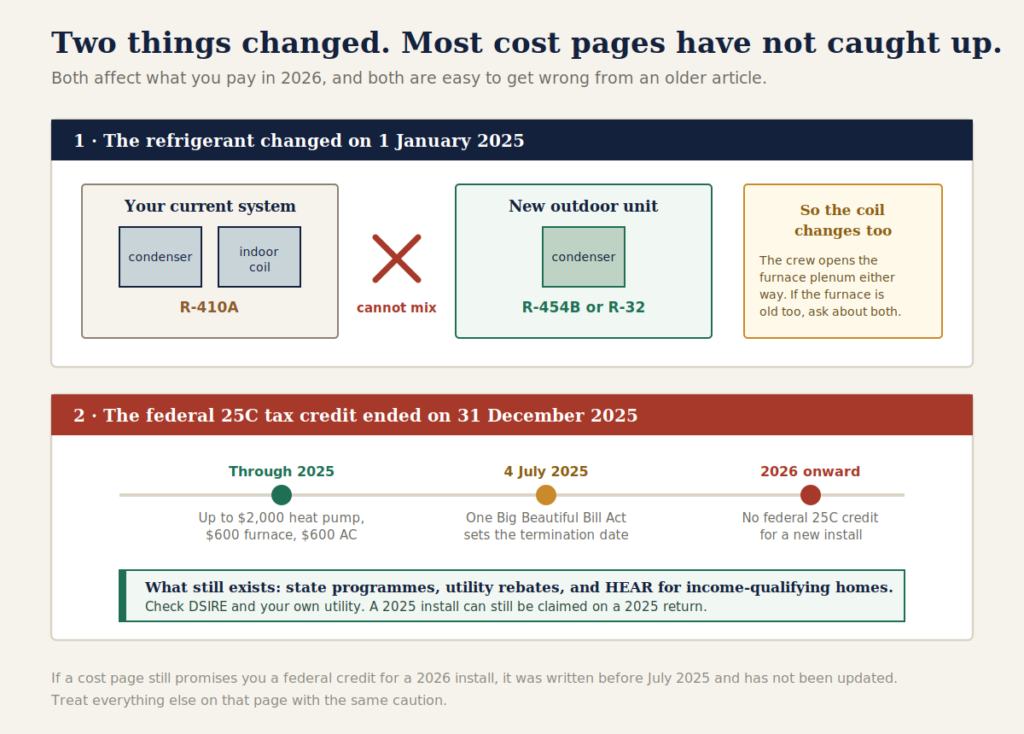
Two things changed recently that most cost pages have not caught up with. The refrigerant in new equipment changed at the start of 2025, which quietly turned some AC-only jobs into bigger jobs. And the federal tax credit that every older article promises you ended on 31 December 2025. Both are covered below, with sources.
What is the average furnace and AC replacement cost?
Replacing both together runs roughly $7,000 to $14,000 installed at standard efficiency, and $10,000 to $20,000 for high-efficiency equipment, in a typical 2,000 square foot home. A furnace on its own falls between $3,000 and $7,500 at 80% AFUE. An air conditioner on its own sits between $3,800 and $7,500 at the regional minimum efficiency.
| What you replace | Standard efficiency | High efficiency |
|---|---|---|
| Furnace and AC together | $7,000 to $14,000 | $10,000 to $20,000 |
| Furnace only | $3,000 to $7,500 | $5,000 to $10,000 |
| Air conditioner only | $3,800 to $7,500 | $6,000 to $12,000 |
| Heat pump conversion | $8,000 to $14,000 | $14,000 to $20,000 |
Those bands are wide because the gear is a smaller share of the bill than people expect. Labour usually runs close to the cost of the unit itself. Parts and permits are a modest slice. The rest covers overhead, warranty risk and the crew’s time. As a rough check, the fitted price lands near double the gear cost in cheap markets, and closer to triple in dear ones.
The calculator above breaks the job into its actual parts rather than handing you one number: the outdoor unit, the furnace or air handler, the indoor coil when the refrigerant rules force one, condensing venting, ductwork, the permit, and anything you add. Each line prints the factors applied to it, so you can see why the total moved.
Why the same house gets very different quotes
Three contractors can look at one house and price it three ways, all defensible. The first reuses your ducts. Number two prices sealing, while the third prices new ducts outright. Efficiency splits them too: a variable-speed system costs nearly twice as much to buy and much less to run. Permits vary as well, so check whether yours is in the price.
None of that is dishonest. It does mean a headline number tells you almost nothing until you know what sits underneath it. Compare scope first, price second.
Is the size they quoted right?
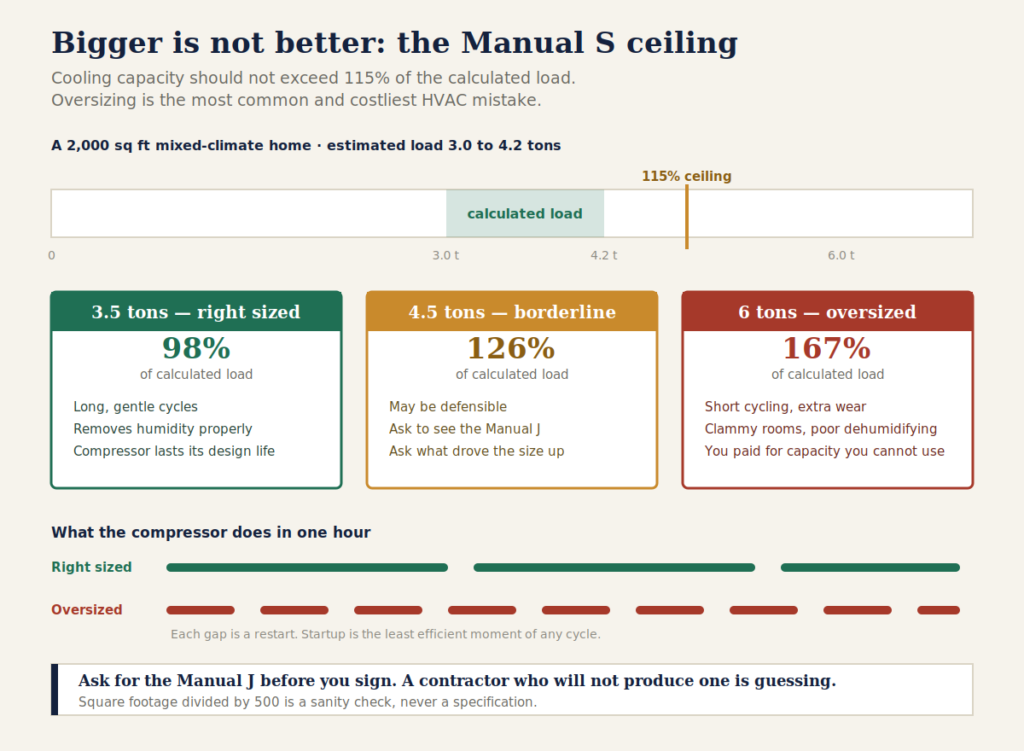
Ask for the Manual J load calculation before you sign anything. Sizing by square footage alone is the single most common and most expensive mistake in residential HVAC, and it almost always errs the same way: too big.
Here is why it happens. The old shortcut is one ton of cooling per 400 to 600 square feet. It takes thirty seconds and needs no tools. But it ignores insulation, glass area, air leaks, ceiling volume and your local design temperature. Anyone using it tends to round up, because nobody wants a callback on the hottest day of the year. So the house ends up with more system than it can use.
What an oversized system actually does to you
It hits the setpoint fast, shuts off, then fires up again minutes later. Trade name for that: short cycling. Every restart is the least efficient moment of a cycle, so bills rise rather than fall. Meanwhile the compressor, the priciest part you own, takes several times the wear it was built for.
Worse, in a humid climate the house never feels right. An AC dries the air by running long enough for water to form on the coil. A system that hits temperature in eight minutes never gets there. You sit at 72 degrees and clammy, wondering why a costly new system feels wrong.
And you paid for the extra capacity twice: once at purchase, and again every month in energy.
The check this calculator runs
Type the tonnage your contractor proposed into the sizing field. We compare it against the load range built from your square footage, climate, insulation, ceiling height and sun. Then we measure it against the ACCA Manual S ceiling, which caps cooling at 115% of the load.
There is a second field for the furnace output BTU, and it runs the same test on the heating side. Manual S allows more headroom there, 140% rather than 115%, because an oversized furnace does not carry the humidity penalty an oversized air conditioner does. It still short-cycles and still heats unevenly, so the check is worth running.
You get one of three answers. Right sized means it sits inside the ceiling. Borderline means it passes against the top of the estimated range but not the middle, so it may be justified and you should ask what justified it. Oversized means it exceeds the ceiling even on the most generous reading of your load, and you should ask to see the Manual J that supports it.
Note carefully what the calculator does not do. It does not give you a single tonnage to buy from. A load estimate built from six inputs is not a Manual J built from a room-by-room survey, and pretending otherwise would repeat the exact error this section warns about. Use the range to test a quote, not to place an order.
Should you replace the furnace and AC at the same time?
If both units are over roughly twelve years old, price them together before you decide. The saving is real, though it is smaller than sales conversations usually suggest: one mobilisation, one permit, one teardown of the same plenum, rather than paying for all of that twice.
There is a mechanical argument as well. Efficiency ratings are certified for specific combinations of outdoor unit, indoor coil and furnace or air handler. Bolt a new variable-speed condenser onto a twenty-year-old single-stage furnace and both run in their least capable mode. You paid for a SEER2 number the installed combination cannot reach, and a mismatched pair can void the manufacturer warranty.
The refrigerant rule that changed this decision
From 1 January 2025, manufacturers stopped building residential split systems that use R-410A. New equipment uses R-454B, or R-32 in most ductless units. These are not interchangeable: you cannot put a new R-454B condenser on an old R-410A indoor coil.
So if your current system is R-410A and you replace only the outdoor unit, the indoor coil comes out anyway. That means opening the furnace plenum regardless. If the furnace is also near the end of its life, you are choosing between doing the second half now at shared labour, or paying to open the same assembly again in a few years. The calculator adds that forced coil line automatically when your inputs call for it.
Your existing R-410A system stays legal to run and repair. The phase-out hits new production, not the unit in your house. But a leak now costs more: supply is shrinking and prices have climbed hard, which shifts the repair-or-replace maths on an older system.
What moves a furnace and AC replacement cost
Efficiency tier
Federal minimums now vary by region. Northern states require 13.4 SEER2 on a split-system air conditioner; the Southeast and Southwest require 14.3 SEER2 below 45,000 BTU. Furnaces must hit at least 81% AFUE nationally. Moving up from the minimum to a two-stage or variable-speed system adds real money at purchase and returns it slowly through lower running costs, faster in a climate that runs the system hard.
Condensing furnaces cost more to install, not just to buy
A furnace above about 90% AFUE pulls so much heat from the flue gas that the exhaust turns to water. So it vents through PVC, not metal, and needs a drain. Moving up from an 80% unit? Budget that work as its own line. The tool adds it when you pick a condensing tier.
Ductwork
Reusing existing ducts is normal and usually fine. But ducts sized for an older, less efficient system can throttle a new one, and you lose the efficiency you paid for. Ask the contractor to measure static pressure rather than assume. Sealing and minor repair is modest money; partial or full replacement is one of the largest single lines on any HVAC quote.
Access and location
A basement or garage installation is straightforward. An attic in July, or a crawlspace you have to drag equipment through, adds hours before anyone connects anything. Location is one of the biggest differences between two quotes on identical equipment.
Electrical and controls
Most like-for-like swaps need no electrical work. A heat pump often does, because the heating load moves onto your panel. Ask about breaker space early, not once the crew is on site.
Are there tax credits for a furnace and AC replacement in 2026?
No. The federal Section 25C credit ended on 31 December 2025. It was cut short by the One Big Beautiful Bill Act, signed 4 July 2025, for any system placed in service after that date. The IRS confirms this in its own guidance. Buying the equipment earlier does not help, because what counts is the install date.
This matters because several cost calculators still tell 2026 visitors they can claim $1,200, or $2,000 on a heat pump. On a $12,000 purchase that is not a rounding error. If you budgeted around a credit that no longer exists, you are short.
What still exists is worth chasing. Many states run their own programmes, several with meaningful money attached. Utilities frequently offer rebates on high-efficiency equipment, sometimes paid at the point of sale through the contractor. The federal HEAR rebate programme remains available for income-qualifying households where the state has launched it. Start with the DSIRE database and your own utility’s website, and ask the contractor which rebates they process directly.
One exception: if your system was installed and placed in service on or before 31 December 2025, you can still claim 25C on your 2025 return. Confirm with a tax professional rather than with a calculator.
Reading a furnace and AC replacement cost quote
A quote you can compare has six things in it. Anything missing is a question, not necessarily a problem.
- The Manual J load calculation in writing, not a verbal assurance that they sized it.
- Manual S selection, showing the chosen equipment against that load.
- An AHRI certificate for the exact indoor and outdoor pair they will fit. Ratings only hold for a certified match.
- The permit, pulled by the contractor, with an inspection scheduled.
- Commissioning. They measure airflow, verify the charge, record static pressure, and hand you the figures.
- Warranty registration in your name, inside the maker’s window. That window is often just 60 or 90 days.
Use the quote check in the calculator to compare a bid against the scope you selected. It reports the difference in plain words and never tells you a contractor is fair or unfair, because that judgement needs information no calculator has.
Why is my quote so much higher than the online estimate?
Usually scope, sometimes sizing. Check whether the quote includes ductwork you did not price, a condensing venting conversion, an indoor coil forced by the refrigerant change, or a higher efficiency tier than you assumed. Then check the tonnage against the sizing tool. A bid can be high simply because it covers more, and it can be high because it is selling more system than the house needs.
For related planning tools, see the roof square footage calculator, the Hardie siding cost calculator, and the house repiping cost calculator.
Furnace and AC replacement cost calculator FAQs
How much does a new HVAC system cost for a 2,000 sq ft house?
Most complete furnace and AC replacements in a 2,000 square foot home land between $9,500 and $14,000 at mid-range efficiency. Standard-efficiency equipment can come in nearer $7,000, and premium variable-speed systems can pass $18,000.
How long does a furnace and AC replacement take?
A straightforward like-for-like changeout is usually one day. Add a second day for ductwork, an attic or crawlspace installation, a condensing venting conversion, or electrical work. Ask for the schedule in writing if you need heat or cooling overnight.
Can I replace just the AC and not the furnace?
Yes, but the 2025 refrigerant change altered the maths. A new R-454B condenser cannot be matched to an R-410A indoor coil, so the coil is replaced regardless, which means opening the furnace plenum anyway. If the furnace is also old, price both together before deciding.
What size furnace and AC do I need?
Only a Manual J load calculation answers that properly. The calculator on this page gives a load range from your square footage, climate, insulation, ceiling height and sun exposure, which is enough to test whether a contractor’s proposed size is plausible. Use it to question a quote, not to place an order.
Is a higher SEER2 rating worth the money?
In a long cooling season with expensive electricity, yes. A higher tier usually pays back within the life of the equipment. In a mild climate with cheap power, the premium often does not return before the system is due for replacement anyway.
Does the furnace and AC replacement cost calculator include tax credits?
No, deliberately. The federal 25C credit ended on 31 December 2025, so a 2026 installation does not qualify. Adding a credit line would overstate your savings. Check state and utility programmes separately, because those do still run.
Should I repair my old system instead?
Weigh the repair against the age. Past about twelve to fifteen years, a major repair on an R-410A system buys you limited time while refrigerant costs keep climbing. Under about eight years, repair is usually the better value. In between, get the repair quote and compare it against a replacement estimate.
Do I need a permit to replace a furnace and AC?
Almost always, and the contractor should pull it. A permit brings an inspection, which is one of the few independent checks on quality you get. Skipping it to look cheaper removes your safety net, and it can complicate a future home sale.
Is this furnace and AC replacement cost calculator a final quote?
No. It plans, questions and compares. What it cannot do is inspect your ductwork, measure static pressure, run a Manual J, check your panel, or price local labour and code. Use it to walk in prepared, then get everything in writing.
Furnace and AC replacement cost calculator: method, limits and sources
We build a load range from your square footage, climate band, insulation, window quality, ceiling height and sun. Then we price the gear you pick against that load. Four things adjust each line: efficiency tier, access, duct condition, and a capped regional index. You get one planning band. The sizing check tests a proposed tonnage against the ACCA Manual S ceiling of 115%.
Installed-cost figures sit inside publicly reported 2026 ranges. The load model and the efficiency, access and ductwork adjustments are Key Calculators planning assumptions, printed beside the lines they change and overridable with your own quoted rates.
This tool does not inspect your home, perform a Manual J, measure duct static pressure, assess your electrical service, determine code compliance, or replace a licensed contractor’s written proposal.
Method review: The engine ships with an 80-case regression suite covering the load model, the Manual S sizing check, the refrigerant-transition rules, invalid input handling, and quote comparison, plus a browser integration suite. Installed-cost outputs are calibrated so every scope option lands inside the published ranges cited below.
Last reviewed: September 2026