
Land Clearing Cost Calculator | Free Cost Per Acre Estimate 2026
Use this land clearing cost calculator to turn acreage and site conditions into a realistic planning range. Enter the area you plan to clear, describe the vegetation, terrain and access, and pick a clearing method — forestry mulching, cut and haul, or hand and selective clearing. It prints every factor beside the line it changes, so you can compare a real contractor quote against the exact scope you chose.
Most people want a single price per acre. That number rarely exists. One acre of light brush by a driveway costs far less than one acre of big trees on a steep slope. This calculator keeps those gaps visible instead of hiding them behind one flat rate.
Measure safely. Use a plat map, a county parcel viewer, a satellite tool, or a contractor’s own figure. Never walk unstable ground, cross unmarked utilities, or approach leaning trees just to size a job.
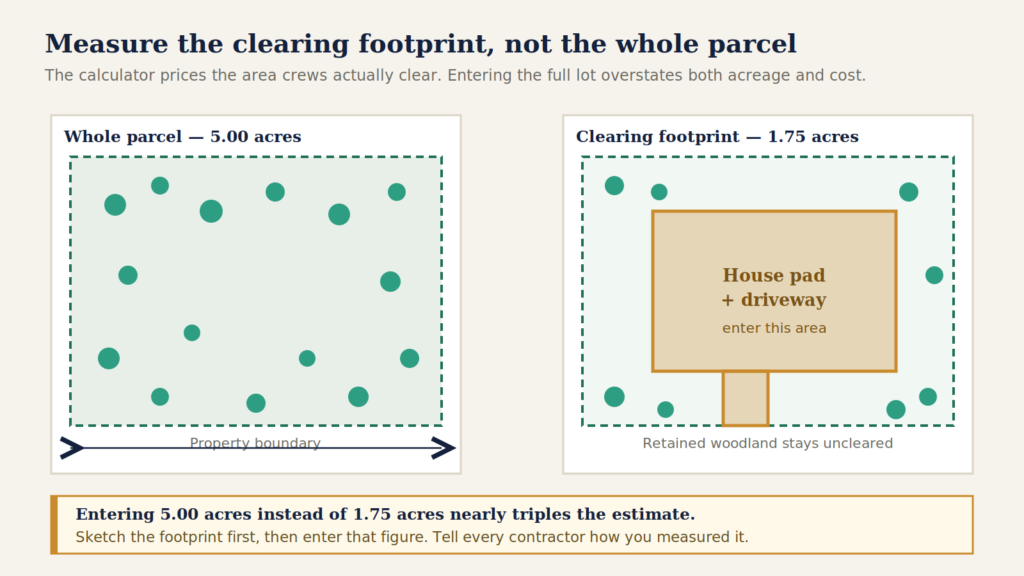
Measure the labeled clearing footprint, not the whole parcel. Entering the full lot overstates both acreage and cost.
How to Use the Land Clearing Cost Calculator?
Getting an accurate range out of this tool takes three inputs and about a minute. First, enter the area you plan to clear in acres, hectares, square feet, square yards or square metres — the tool converts everything to acres automatically. Second, describe the site: vegetation density, terrain, slope and equipment access, since these drive most of the swing between a low and high estimate. Third, choose your clearing method — forestry mulching, cut and haul, or hand/selective clearing — because each one carries a different base rate per acre and a different debris outcome.
Once you submit those three inputs, it returns a planning range rather than a single number, with every adjustment itemized on its own line so you can see exactly what moved the total and why.
How the Land Clearing Cost Calculator Estimates Your Project?
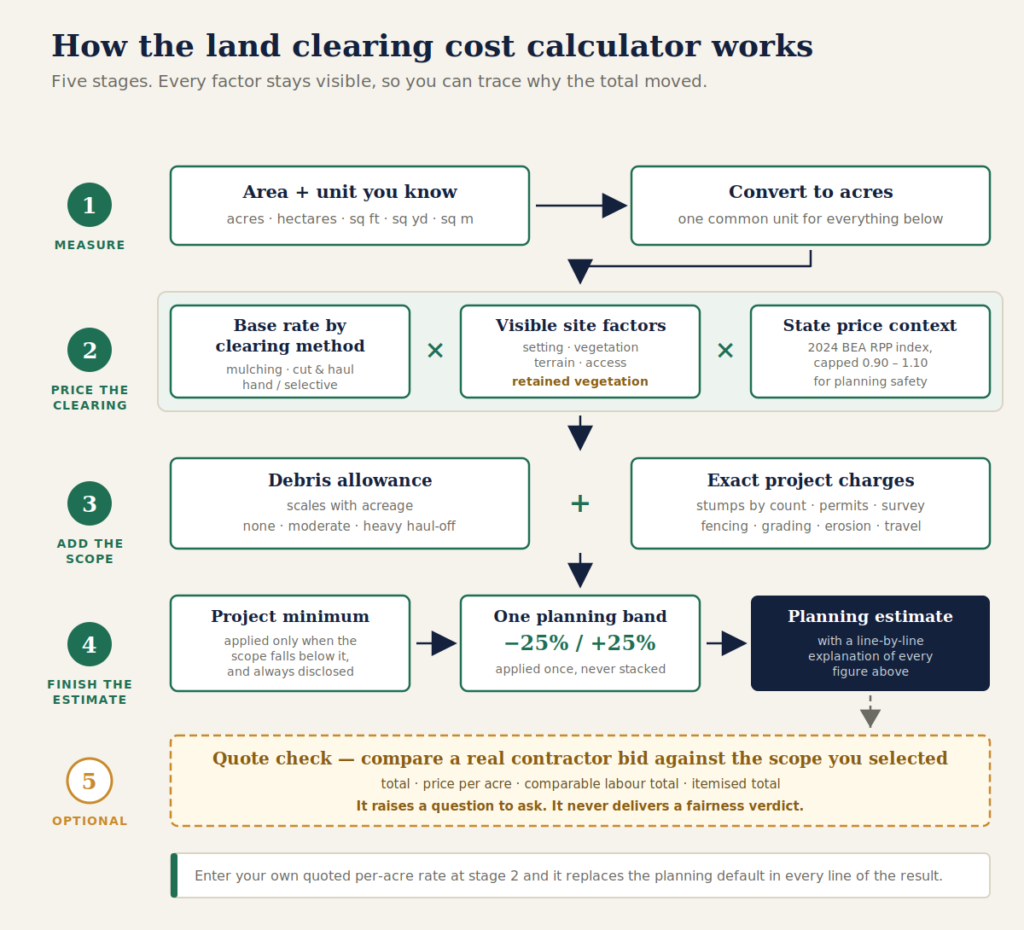
The calculator starts with area. Enter acres, hectares, square feet, square yards or square metres. It converts your figure to acres first. Then it multiplies that acreage by a base rate for your chosen method, and adjusts for setting, vegetation, terrain and access. Each factor prints next to the clearing line, so you can see why the total moved.
Next, the tool splits area-driven work from fixed charges. Debris handling scales with acreage. Permits, survey work, fence removal and travel do not. Stumps price by the count, so the tool asks for one rather than guessing. Skip a count and the result says so plainly. It never prints a tidy zero that looks like a real answer.
Finally, the tool applies a minimum project charge and one planning band. Small jobs often cost more than acreage suggests, because a crew still hauls equipment out for a half-acre lot — a mobilization cost that exists whether the job is one acre or ten. When that minimum drives your total, the tool says so and hides the cost-per-acre figure. Dividing a fixed minimum by a sliver of an acre gives a scary number that means nothing.
Enter Your Own Rate for the Sharpest Answer
The base rates here are Key Calculators planning defaults. They are not survey data and not a price list. If a contractor already gave you a per-acre figure, type it into the optional base rate field. Your number then replaces the default and drives every line below. That one step turns this tool into a check on the numbers you already hold, rather than a guess in place of one.
Land Clearing Cost Per Acre
Contractors quote most clearing work by the acre, so this calculator uses the same unit. The rate card below sets the starting point. Site factors and regional context then adjust it.
| Clearing method | Planning base per acre | What crews actually do |
|---|---|---|
| Forestry mulching | $2,400 | A mulcher grinds brush and small trees where they stand and leaves the chips on site. |
| Cut and haul | $4,200 | Crews fell, load, transport and dispose of material off site, sometimes paying dump fees. |
| Hand or selective clearing | $6,800 | Crews work by hand around trees you keep, or in ground machines cannot reach. |
Treat these as a starting point, not a promise. Quotes move with fuel prices, season, haul distance, dump fees, and how badly a contractor wants the work. The state selector applies a capped regional index from the 2024 BEA Regional Price Parity dataset. That index tracks broad living costs, not clearing prices in your county.
How Much Does It Cost to Clear an Acre of Land?
For one acre of mixed brush on rolling ground with decent access, the estimate usually lands in the low-to-mid four figures once debris handling joins in. Light brush on flat ground costs less. Big trees, steep ground or tight access push it much higher, and often past the point where you need an arborist rather than a calculator.
Remember that the minimum charge can dominate a one-acre job. Ask every contractor for their own minimum. It varies far more between firms than the per-acre rate does.
What Changes Your Land Clearing Cost Calculator Result?
Five site factors move the total more than any other input. The calculator prices each one as its own visible line, so you can see exactly which conditions are driving your number up or down.
Acreage and How You Measure It
Measure the area crews will actually clear. If you only need a house pad, a drive and a septic field, enter that footprint, not the whole parcel. Owners often triple their own estimate by typing in the deed acreage. Sketch the footprint first, write the number down, and tell every bidder how you got it.
Vegetation Density and Tree Size
Light brush feeds through a mulcher fast. Heavy brush slows it down. Big hardwoods change the job, because crews must aim the fall, handle thick wood, and often bring other machines. The calculator flags mature-tree jobs for onsite review rather than pretending one multiplier covers the risk.
Terrain, Slope and Equipment Access
Flat, dry ground lets machines run long passes. Slope, rock, wet soil and rough ground all cut output and can force smaller machines. Access matters just as much. A narrow gate, a soft culvert, or a long haul from the staging area adds hours before anyone clears a tree.
Retained Vegetation
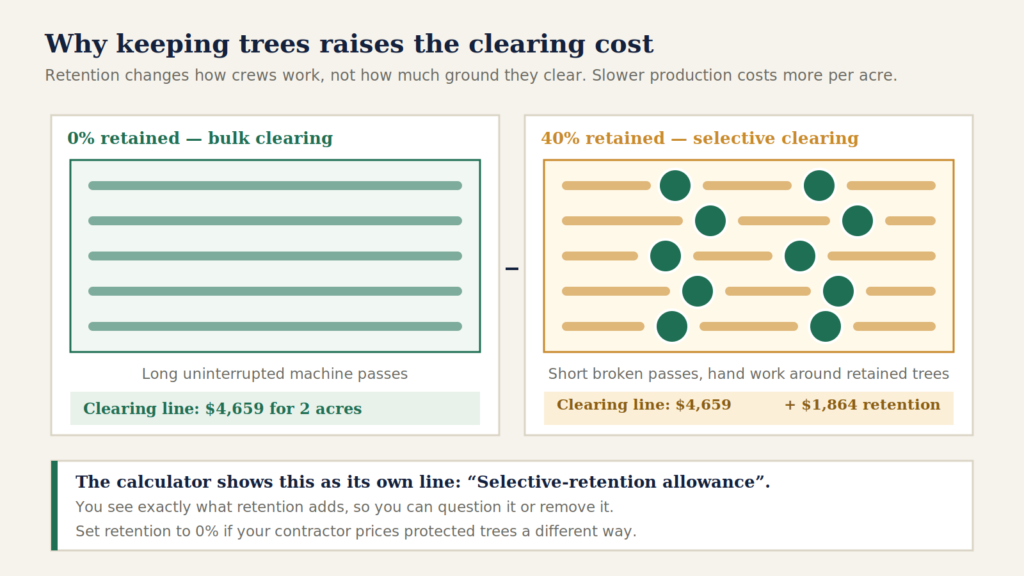
Keeping trees does not save money. Operators weave around what stays, aim their drops, and swap bulk output for hand work. So retention raises the cost of clearing the ground that remains. The calculator prints this as its own line, the selective-retention allowance. You can see the amount, question it, or set it to zero.
Long uninterrupted passes clear ground fast. The labeled retained trees break those passes, and the tool prices that lost production as its own line.
Debris, Stumps and Follow-On Work
Ask each contractor what happens to the material. Mulching leaves chips on site. Cut-and-haul takes them away and adds transport and dump fees. Burning depends on local rules and burn bans. Grinding shaves a stump below grade. Removal pulls the root ball and leaves a hole to fill. These are different jobs at different prices, and neither lands in your total until you pick it.
Grading and erosion control often follow clearing, where runoff, bare soil or a permit demands them. The tool lists both as visible allowances, so a cheaper bid cannot look equal just because it stops at the tree line.
Estimate Land Clearing Cost by Hand
You do not need to trust a total you cannot check. Work through these steps and you can sanity-test any figure a contractor, a competing tool, or this calculator gives you.
- Measure the clearing footprint and convert it to acres.
- Pick the clearing method that matches the quote you want to compare.
- Multiply acres by the base rate for that method.
- Adjust for setting, vegetation, terrain and access, one factor at a time.
- Add debris handling, which usually scales per acre.
- Add fixed charges: stumps by the count, plus permits, survey, fencing, grading, erosion control and travel.
- Compare the result against the contractor’s minimum project charge and use whichever is larger.
A Two-Acre Worked Example
Take two acres of mixed brush and small trees on rolling ground in Texas, with moderate access, cleared by forestry mulching with moderate haul-off. Two acres at $2,400 gives $4,800. Every site factor here sits at neutral. The Texas regional factor of 0.971 then trims the clearing line to about $4,659. Debris handling adds roughly $1,359. The total lands near $6,018, and the land clearing cost calculator shows a range of about $4,513 to $7,522.
Check a Contractor Quote With the Land Clearing Cost Calculator
Enter the bid in the quote check section once it arrives. Supply a project total, a price per acre, a comparable labour total, or an itemised total. The tool multiplies only the per-acre entry by your acreage. It never invents hours from an hourly rate, and it never calls a contractor fair or unfair.
Look past the percentage. Compare the same acreage, method, debris plan, stump scope, and the same treatment of permits, disposal, travel and grading. A bid far below your estimate may cover mulching alone while your scope includes haul-off and forty stumps. It may equally flag a line someone forgot.
Ask every contractor to put inclusions and exclusions in writing. Do stumps come out, or just get ground? Who pulls permits and calls for utility locates? Does grading mean rough or finish? Does the price cover travel, disposal and return visits? Write the answers beside your result.
For related planning tools, try the roof square footage calculator, the Hardie siding cost calculator, or the house repiping cost calculator. Each one shows its inputs, prints its formula, and names what still needs professional verification.
When a Low Estimate Deserves a Second Look
A low number is not always wrong. Light brush, easy access, onsite mulching and a small footprint all cut cost fairly. The same number can also mean a bidder left out stumps, haul-off, permits or grading. Treat the ledger as a checklist, not a verdict. Book an onsite review when the site is large, wet, steep, or close to buildings and utilities.
Frequently Asked Questions About the Land Clearing Cost Calculator
How much does it cost to clear one acre of land?
Cost depends on method, vegetation, terrain, access and debris. A minimum charge can also drive a one-acre job, which lifts the effective per-acre figure above the rate card. Enter your real scope into the land clearing cost calculator rather than trusting one headline rate.
How much does it cost to clear five acres?
At five acres, production usually outweighs the minimum charge, so method and haul-off matter most. Use the calculator’s range to compare bids that describe the same scope.
How much does it cost to clear ten acres?
Ten-acre jobs turn on logistics: disposal, access roads, retained trees and staging. Book an onsite review before you commit, above all on big-tree or mixed-terrain sites.
Is forestry mulching cheaper than cut and haul?
Usually yes, because mulching grinds material where it stands and skips loading, transport and dump fees. The mulch does stay on your ground, so pick cut-and-haul when you need a clean surface.
Does the land clearing cost calculator include stump removal?
Only when you pick it. Grinding and removal both price per stump, so the tool asks for a count. Leave it blank and the result says plainly that it skipped the stump line.
Can timber or firewood offset my clearing cost?
Sometimes, but never count on it. Salvage value needs the right species, volume, access, gear and a buyer within haul range. Ask whether the bid includes, credits or excludes salvage.
Do I need a permit before clearing land?
Rules vary by state, county and site. The tool offers a visible permit allowance, but it cannot tell you whether your project qualifies. Call the local authority and check utilities, wetlands, habitat and erosion rules before work starts.
Why does keeping trees increase my estimate?
Retention changes the method, not the acreage. Crews slow down, use smaller machines, and add hand work on the ground they still clear. The selective-retention allowance shows that cost as its own line, so you can adjust it.
Can this land clearing calculator replace a contractor’s bid?
No. It plans, questions and compares. It cannot inspect your land, verify boundaries, judge tree hazards, confirm disposal rules or promise a price. Walk into the conversation prepared, then ask for a written scope.
Method, limits and sources
The land clearing cost calculator uses a plain per-acre model. It takes acreage times a method base rate, adjusts for four named site factors and a capped regional index, adds per-acre debris handling and itemised fixed charges, applies a minimum project charge, and shows one planning band. It does not inspect the site, track local market prices, judge tree risk, rule on permits, or replace a contractor’s takeoff.
The base rate card is an internal Key Calculators planning default. It is not survey data and not a contractor price list. Enter your own quoted per-acre rate whenever you have one, because your number always beats our default.