
Stump Grinding Cost Calculator | Cost Per Diameter by Stump Size
Use this stump grinding cost calculator to turn stump measurements into a planning range you can take to a tree service. Enter each stump’s diameter, tell the tool where you measured, pick a grind depth, and it prices the job the way contractors actually do: by the diameter inch. You can also enter a real quote and compare it against the scope you selected.
Stump grinding costs $3 to $5 per diameter inch for a single stump, with most jobs landing between $100 and $450 once the minimum service charge is applied. Published guides put the national average around $270 to $325 per stump, though your own total will depend on diameter, wood species, grind depth, and site access — which is exactly what the calculator below accounts for.
Stump grinding cost calculator
Almost every tree service prices stump grinding per diameter inch. That makes the arithmetic simple. It also makes one mistake very expensive, because most homeowners measure the wrong part of the stump and get a shock when the crew arrives.
Measure safely. Stay off unstable ground, keep clear of leaning trees, and never probe around a stump before you know where the utility lines run.
The labeled cut top is the flat surface where the tree came down. The labeled root flare is where the trunk meets the soil. Contractors price on the flare.
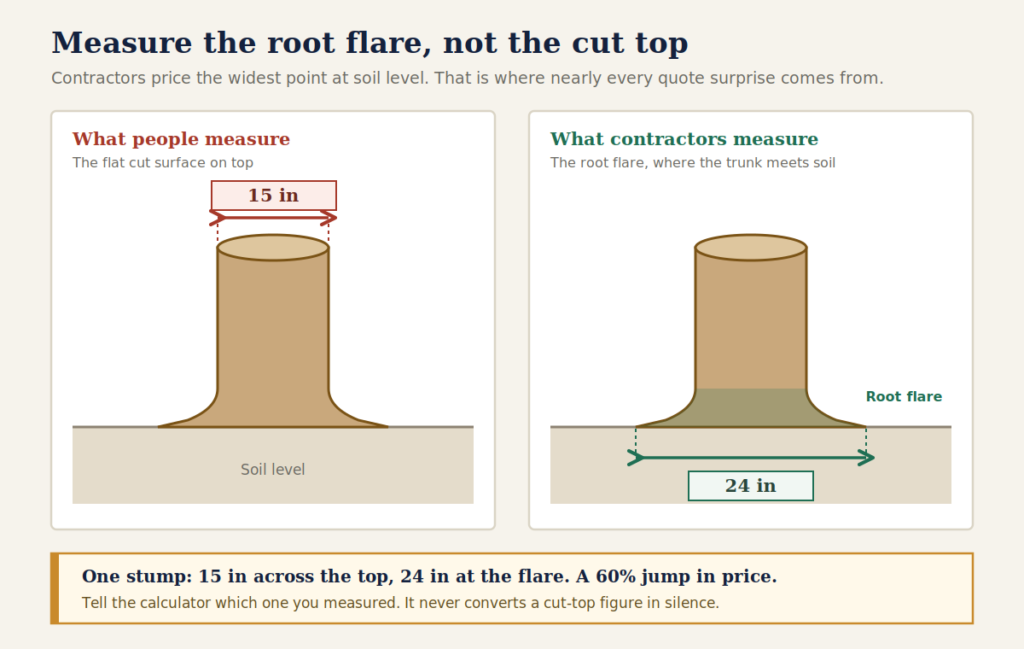
Where do you measure a stump for a quote?
Measure the widest point at soil level, where the trunk flares out into the ground. Not the flat cut surface on top, and not the trunk at chest height. That flare is what the grinder has to chew through, so that is what your bill reflects.
The gap surprises people. A trunk that looks 15 inches across often measures 24 or 25 inches at ground level. Hardwoods such as oak, maple and sweetgum flare hard. Pines flare much less. If roots have humped the soil up around the base, include that hump in your measurement.
This stump grinding cost calculator asks where you measured, and it treats the two answers differently. Tell it you used the cut top and it marks the result provisional, shows a wider band, and asks you to go back with a tape. It never converts your number in silence and then presents the result as firm. Other calculators put this warning in an article and then ignore it in the maths.
A quick way to measure
Lay a tape across the base at its widest point, at soil level, and read the number. Stumps are usually oval, so take the widest reading. Photograph the stump with the tape in shot. Contractors quote from that photo far more happily than from a description.
How much does stump grinding cost?
Most tree services charge $3 to $5 per diameter inch for the first stump, $2 to $3 per inch for each additional stump on the same visit, and apply a minimum charge of roughly $95 to $150. A 20-inch stump therefore costs about $80 of grinding, which the minimum usually absorbs.
Published pricing guides and working tree services agree on that model. First stumps typically run $3 to $5 per diameter inch. Additional stumps on the same visit drop to roughly $2 to $3 per inch, because the crew has already hauled the machine to your property. Most companies then apply a minimum charge of about $95 to $150 to cover travel and setup.
Some companies price by the hour instead of by the inch, typically $125 to $200 per hour, especially for jobs with several stumps or awkward access. If you get an hourly quote, ask how many hours they expect the job to take so you can compare it against a per-inch estimate.
Those figures come from published sources rather than from us, and we cite them at the foot of this page. Your own quoted rate always beats a published average, so type it into the rate field and the calculator uses yours instead.
Stump grinding cost by size
| Stump Size | Diameter | Typical Cost |
|---|---|---|
| Small | Under 12 in | $95 – $150 (minimum charge) |
| Medium | 12 – 24 in | $95 – $250 |
| Large | 24 – 36 in | $150 – $400 |
| Extra-large | Over 36 in | $400+ (ask for a tiered quote) |
Most single small-to-medium stumps land at or near the minimum service charge rather than the per-inch rate. Diameter only starts driving the price on its own once a stump passes roughly 18 to 20 inches.
Stump grinding cost per inch
| Stump diameter at the flare | Rough grinding cost at $4/inch | What usually governs the price |
|---|---|---|
| Under 12 in | $48 or less | The minimum charge, almost always |
| 12 – 18 in | $48 – $72 | Still often the minimum charge |
| 18 – 24 in | $72 – $96 | Diameter starts to drive the price |
| 24 – 36 in | $96 – $144 and rising fast | Grinding volume, not the per-inch rate |
| Over 36 in | Ask for a size-tier quote | Machine time, teeth wear and chip volume |
Why does the stump grinding cost calculator flag large stumps?
Because grinding volume rises with the square of the diameter, not in a straight line with it. Double the width and you roughly quadruple the wood the machine must pulverise.
A per-inch price assumes cost rises in a straight line with diameter. Grinding does not work that way. Double the diameter and you roughly quadruple the wood the machine must pulverise, because area grows with the square of the radius. A 30-inch stump is not twice the job of a 15-inch stump. It is closer to four times.
Experienced estimators know this and add size tiers above 24 inches. Our calculator shows you both numbers: the straight per-inch figure you will probably be quoted, and a geometric check that scales with grinding area. When your largest stump passes 24 inches, the tool flags the gap and tells you to ask whether the quote uses a flat rate or a tier. No other calculator we found does this.
What makes one stump cost more than another?
Five things: wood hardness, grind depth, surface roots, equipment access, and how many stumps you book at once. Diameter sets the baseline, and these five move it up or down. The calculator prints each one beside the line it changes.
Wood species and hardness
Oak, maple, hickory and beech are dense. They stress the machine, dull the carbide teeth quickly and take longer. Pine, fir, poplar and palm cut fast. Most companies charge a premium for hardwood to cover the extra time and tooth wear.
Grind depth below grade
Standard grinding goes 6 to 8 inches below the surrounding soil. That depth suits lawn repair. Planning to replant in the same spot? Crews go 10 to 12 inches. Building a patio, driveway or foundation over the site? Expect 12 to 18 inches. Depth changes both the price and the amount of topsoil you need afterwards, so the calculator takes it as an input rather than assuming.
Surface roots
Maples and pines throw roots that run for feet across a lawn. Grinding those is called chasing the roots, and it adds real labour. Ask for it explicitly if you plan a walkway, patio or fence line through the area, because those roots will rot and the ground above them will settle.
Equipment access and gate width
A self-propelled grinder weighs between 1,500 and 3,500 pounds. If your only route to the back yard is a standard 36-inch gate, the crew swaps to a walk-behind machine that cuts far more slowly. That one constraint can add more to a bid than the species does. Measure your gate before you call, and mention it.
Booking multiple stumps at once
The first stump absorbs the travel and setup charge. Additional stumps ground on the same visit typically cost 30 to 50 percent less each, so it’s worth grouping stumps into one appointment — or splitting a visit with a neighbor who also needs one ground.
The labeled grind depth sets both the price and the size of the hole. The labeled chip pile is roughly three times the volume of the wood removed.
Does location change the price?
Yes, typically by around 15 to 25 percent in either direction. Labor rates in coastal metros and the Northeast tend to run higher, while parts of the Southeast and Midwest run lower. Permits, HOA approval, and utility-marking requirements also vary by municipality and can add to the total in some areas.
Rather than apply a flat multiplier that overcorrects for your area, the calculator applies a capped regional index. Enter your ZIP code in the tool above for a range adjusted to your local market.
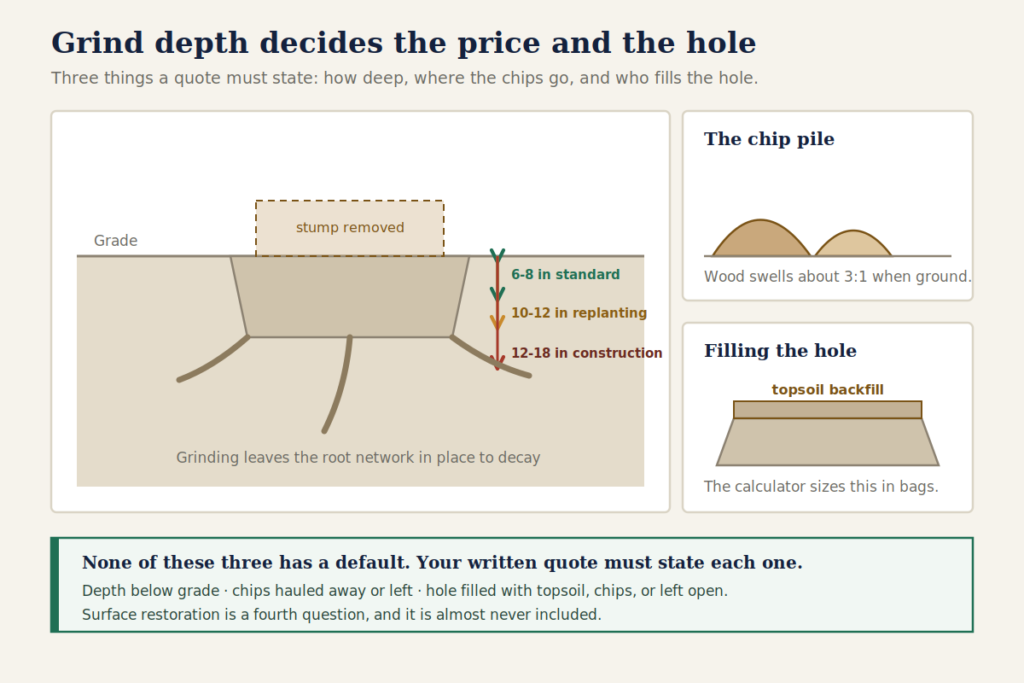
Chips, the hole and putting the lawn back
Grinding produces far more material than anyone expects. Solid wood swells roughly three to one once it is chipped, so a moderate 20-inch stump can leave 15 to 20 cubic feet of loose chips and soil. Left in a pile, that smothers grass.
You have three choices. Leave the chips to settle and decompose over six to twelve months. Spread them as mulch in beds, but never around a tree that died of disease. Or pay to have them hauled away, which usually runs a few dollars per diameter inch on top of the grinding.
Our calculator estimates the chip volume and the topsoil you need to backfill the hole, in cubic feet, cubic yards and standard 0.75 cubic foot bags. That is pure geometry, so no pricing assumptions creep in. We have not found another stump grinding calculator that reports it, yet it is the number you need at the garden centre on Saturday.
Get the scope in writing
Three things have no default, so a quote must state each one. How deep does the grind go below grade? Do the chips stay or go? Does anyone fill the hole, and with what? Surface restoration is a fourth question and it is almost never included unless the quote says so. The calculator prints these four as a checklist beside your estimate.
Should you grind the stump or dig it out?
Grind it, unless you are building on that exact spot. Grinding costs roughly a third of full excavation, leaves your lawn intact, and kills the stump just as dead.
Grinding shaves the stump below grade with a spinning carbide wheel and leaves the roots to decay naturally. Full removal digs out the whole root ball with an excavator. That costs roughly two to three times more, tears up the lawn, leaves a crater needing tons of fill, and risks shallow utility lines.
Grinding suits almost every homeowner. Choose full removal only when you are building over the exact spot, or when a structure needs the root mass gone. Ask your contractor which one the quote covers, because the two words get used loosely and the price difference is large.
Check a contractor quote with the stump grinding cost calculator
Enter the bid once it arrives. You can supply a project total, a price per diameter inch, a price per stump, or an itemised total. The calculator compares it against the scope you selected and reports the difference in plain words. It never calls a contractor fair or unfair.
Hand the contractor your total diameter inches. That single number is what they price on, and homeowners almost never work it out. Giving it to them speeds up the quote and makes two bids genuinely comparable.
A bid above your estimate is not automatically wrong. Check whether it covers root chasing, deeper grinding, chip haul-away, topsoil, or a walk-behind machine your gate forced on them. A bid well below your estimate may simply exclude those things. For related planning tools, try the roof square footage calculator, the Hardie siding cost calculator, or the house repiping cost calculator.
Call 811 before anyone starts
This is the one item on the page that can hurt someone. Stump grinders cut below grade, and gas, electric, water, sewer and fibre lines run through residential yards more often than people expect. Calling 811 is free, most states require it by law before any digging, and marking takes about three business days. Book the locate before you book the crew.
Some municipalities also require a permit or HOA approval for stump grinding, particularly for larger jobs or properties near shared property lines — check with your local building department before scheduling.
Stump grinding cost calculator FAQs
How long does stump grinding take?
A single ordinary stump takes 15 minutes to an hour of machine time, plus setup. A 40-inch hardwood with wide root flare can run past an hour on its own. Most residential visits finish in half a day, including cleanup.
Does the tree species change the price?
Yes. Oak, maple, hickory and beech are dense, so they slow the machine and wear the carbide teeth faster. Pine, fir, poplar and palm cut quickly. Expect a premium on hardwood and a discount on softwood.
Why is my quote higher than the stump grinding cost calculator estimate?
Usually because you measured the cut top and the contractor measured the root flare. A 15-inch top can be a 24-inch flare, which changes the price by more than half. Depth, root chasing and gate access account for most of the rest.
Why is stump grinding so expensive?
The per-visit minimum charge covers travel, equipment transport, and setup — costs that exist whether the stump is small or large. On top of that, grinding volume rises with the square of the diameter, so a large or dense hardwood stump takes disproportionately longer to grind than its size alone would suggest, which drives up labor and equipment wear.
Is it cheaper to grind several stumps at once?
Yes, and the saving is large. The first stump absorbs the travel and setup charge, so additional stumps on the same visit often cost 30 to 50 percent less each. Group them into one appointment, or split a visit with a neighbor.
Is stump grinding covered by insurance?
Usually not on its own. Homeowners insurance typically only covers stump removal when the stump is blocking repair of other damage that is itself covered — for example, a stump interfering with a water or sewer line repair. Routine stump grinding for aesthetics or lawn care is considered routine maintenance and generally isn’t covered.
How deep does stump grinding go?
Standard depth is 6 to 8 inches below grade, which suits lawn repair. Replanting needs 10 to 12 inches. Construction over the site needs 12 to 18 inches. Agree the depth before the machine starts, because it is rarely written down otherwise.
What happens to the wood chips?
They stay on site unless your quote says otherwise. Grinding produces roughly three times the volume of the wood removed, so expect a large pile. You can leave it to settle, spread it as mulch, or pay for haul-away.
Can I plant a new tree in the same spot?
Wait, or move over. Decaying chips pull nitrogen out of the soil for months, and the old root mass makes digging hard. Plant 5 to 8 feet away, or ask for a deep grind and backfill with fresh topsoil before replanting.
How accurate is this stump grinding cost calculator?
It is a planning range, not a bid. Enter your own quoted per-inch rate and the arithmetic becomes exact. Left on the planning defaults, expect it to land in the right bracket rather than on the nose.
Does grinding kill the roots?
Effectively, yes. Grinding 6 to 10 inches below grade removes the stump’s ability to sprout, and the remaining roots decay over a few years. Some species send up suckers for a season afterwards, so watch the area and cut any shoots.
Is this stump grinding cost calculator a final quote?
No. This stump grinding cost calculator plans, questions and compares. It cannot inspect your property, verify your measurements, locate utilities, or promise a contractor’s price. Use it to ask sharper questions, then get the scope in writing.
The five labeled stages run top to bottom. Stage 1 fixes the measurement, stage 3 applies each named site factor, and stage 5 stays optional.
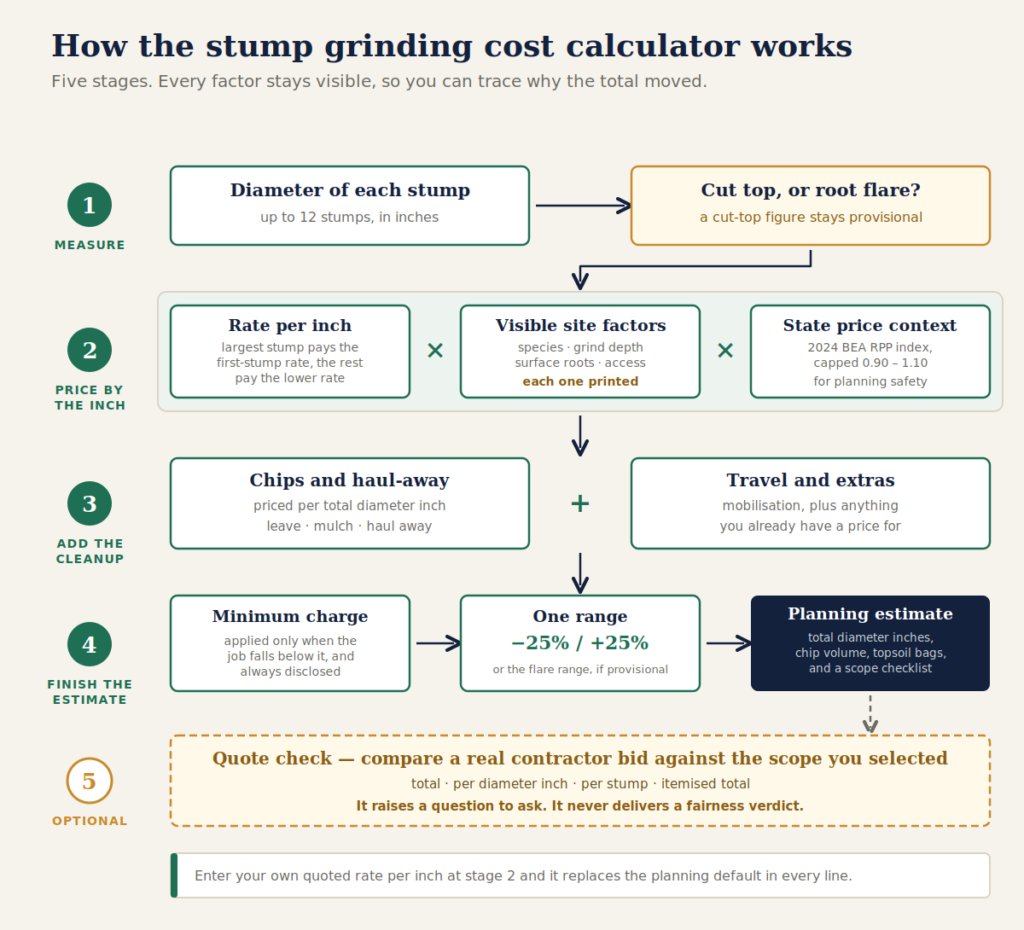
Stump grinding cost calculator: method, limits and sources
The calculator prices each stump by its diameter at the root flare, applies the first-stump or additional-stump rate, adjusts for species, grind depth, surface roots, equipment access and a capped regional index, then adds chip haul-away and any charges you enter. It applies a minimum project charge and shows one planning band. It estimates chip and backfill volume from stump geometry alone.
The per-inch rates and minimum charges come from the published sources below. The species, depth, root and access adjustments are Key Calculators planning assumptions, and the tool prints each one beside the line it changes. Enter your own quoted rate whenever you have one, because your number always beats our default.
This tool does not inspect the site, locate underground utilities, judge tree or soil conditions, determine permit requirements, or replace a written scope from a licensed contractor.
Method review: The calculation engine ships with a 77-case regression suite covering pricing, unit handling, invalid input, minimum-charge behaviour, chip and backfill volume, and quote comparison, plus a 34-case browser integration suite. The chip-volume model is calibrated so a 20-inch stump at standard depth produces the 15 to 20 cubic feet of material that published guidance reports.
Last reviewed: September 2026
- HomeGuide: Tree stump removal cost — per-inch ranges and minimum service fees
- LawnStarter: Stump grinding price guide — additional-stump and hardwood premiums
- Homewyse: Cost to grind a medium tree stump — labour and mobilisation basis
- Call 811 — free underground utility locating before any digging or grinding