
Wood Fence Cost Calculator
This wood fence cost calculator doesn’t hand you a fixed national average. You enter the length, the height, and the material and labor rates from your own bids, and the total shows every line. Please note that the published 2026 guides usually put wood fence cost for a 6-foot privacy run between the low thirties and the low fifties per linear foot, installed. Height, wood type, style, and local labor can push your number either way, so treat that range as a starting point.
Store price tags and big-box panel prices often leave out labor, post holes, concrete, and haul-away. Here, those lines stay on the screen, so you can see what you are really comparing.
Wood fence calculator and cost estimator
Use the tool above as a wood fence calculator and wood fence cost estimator. Start with the total length in feet and the fence height. Add any gates, then pick a wood style such as privacy or picket if the list offers one. Next, type in your local material and labor rates in dollars per linear foot. Waste, removal, tax, and a minimum charge all show up in the total when you set them. Posts and concrete appear too when you turn them on.
How this calculator works
The tool multiplies your fence length by the material rate and the labor rate you enter. Waste adds extra length to the material order, and gates are priced as separate openings. When post estimating is on, post spacing and concrete per post appear as their own lines.
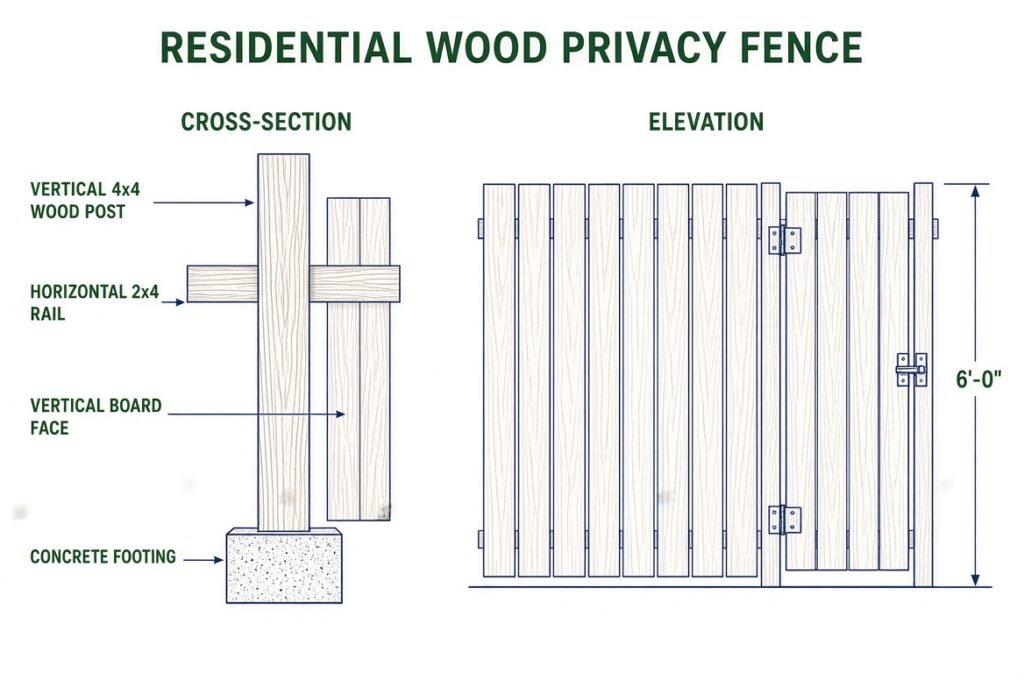
A wood fence is built from posts, rails, and boards, so it helps to know what drives each one. Posts are often set about 8 feet apart unless your quote says otherwise. A 6-foot privacy fence usually has two horizontal rails, so ask your contractor how many a taller fence needs. Board coverage depends on board width and overlap, and board-on-board uses more lumber than a single layer. In cold climates, deeper posts add concrete and labor that a short national average hides. Removal, access, contingency, tax, and a minimum charge are added in a fixed order, so you can follow every line of the total.
The calculator doesn’t check your soil or your local code, and it won’t pick a wood species for your climate. It also can’t replace a written contractor scope. If you plan to dig post holes, call 811 first.
Wood fence cost per foot
Wood fence cost per foot is the number most quotes use. It combines material (boards or panels, rails, and usually posts) with labor (layout, digging, setting posts, and fastening), then adds waste and extras. Material cost for wood fence work is easier to compare between suppliers than labor, since labor changes with the crew and the site. An installed wood fence price per foot rolls all of it into one figure.
National unit-cost examples from 2026 put residential wood privacy fences roughly in the low thirties to the low fifties per linear foot. Taller runs and cedar sit toward the high end. Use any published range as a rough guide when you talk to contractors, not as a bid. Your own total should follow the rates on your local quotes.
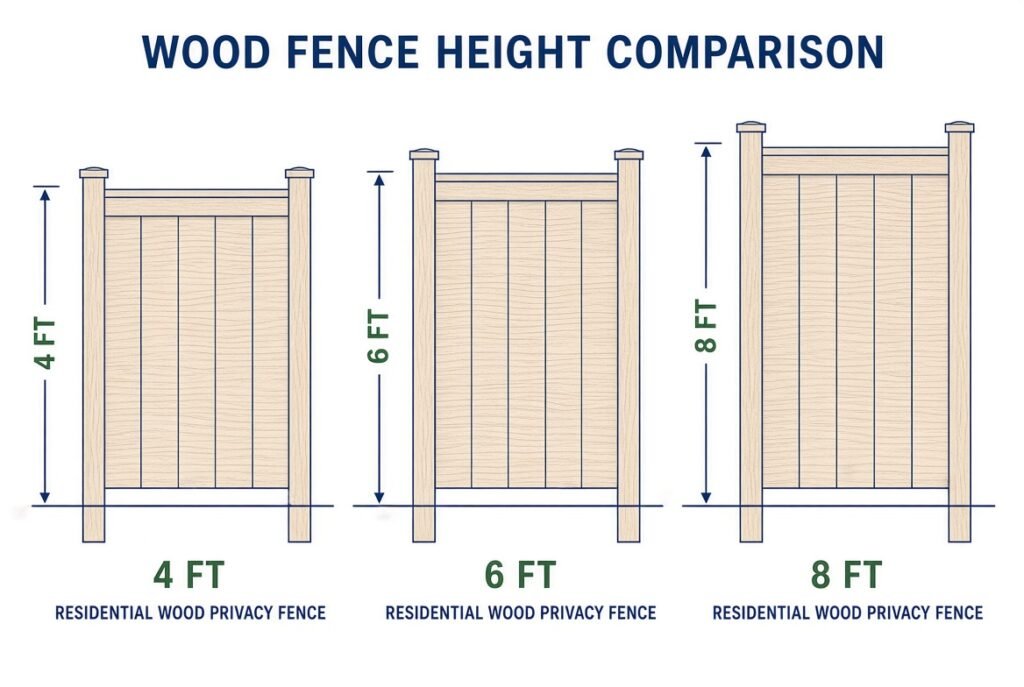
| Height | Style | Planning band per LF, installed |
|---|---|---|
| 4 ft | Picket or low privacy | Often below a 6 ft privacy run |
| 6 ft | Privacy (most common) | About low thirties to low fifties $/LF |
| 6 ft | Picket or semi-open | Often less material than solid privacy |
| 8 ft | Tall privacy | Longer posts and more board area |
Wood fence labor cost per foot
Labor cost per foot depends on soil, slope, and access. Rocky or rooty ground slows digging, and a tight side yard slows the crew. Use the labor rate from your bids instead of a published average, so the total reflects your market.
Wood fence installation cost
Wood fence installation cost is mostly labor, posts, concrete, and site access. What it costs to install a wood fence climbs when the yard is sloped, rocky, or full of roots, and every extra gate adds hardware time.
When you read a quote, split it into material, labor, gates, removal, and haul-away. If a line is missing, ask for it. Doing the work yourself can cut the cash you spend, but you still need an accurate length, post spacing, and a realistic waste allowance. To price materials only, set labor to zero in the calculator.
Cost for common lengths: 50, 100, 150, and 200 feet
How much a wood fence costs depends on length as much as on the per-foot rate. The table below is a rough sketch, so you can sanity-check the size of the number before you ask for bids. Use the calculator with your own rates for the real figure.
| Length | At about $35/LF all-in | At about $42/LF all-in | At about $50/LF all-in |
|---|---|---|---|
| 50 LF | ~$1,750 | ~$2,100 | ~$2,500 |
| 100 LF | ~$3,500 | ~$4,200 | ~$5,000 |
| 150 LF | ~$5,250 | ~$6,300 | ~$7,500 |
| 200 LF | ~$7,000 | ~$8,400 | ~$10,000 |
Worked example (live tool): Say you have 100 feet of 6-foot privacy fence, with material at $22 per foot, labor at $18 per foot, and 10% waste. The tool orders 110 feet of material, because waste applies to material only. Material comes to $2,420, and labor on the 100 net feet comes to $1,800. That gives a core subtotal of $4,220, or $42.20 per foot. Removal, access, and other optional lines add on top when you enter them. Swap in the rates from your own bids.
Cost to replace a wood fence
The cost to replace a wood fence is a different question from a repair bill. You can often fix a few failed posts or a short run of bad boards. If many posts have rotted at the frost line, or the whole fence is cupped and loose, replacing it is usually the cleaner choice.
Ask your contractor for a repair price and a replacement price for the same length, so you can compare. Tear-out and disposal are often separate lines. Once you have a dollar amount for removal, enter it in the calculator.
Cedar, pressure-treated, and other wood types
Pressure-treated pine is widely stocked and usually has the lowest material rate of the common options. The cost of a cedar fence installed is usually higher than basic treated privacy for the same height and length. Redwood sits in a similar premium range where it is sold. Composite products that look like wood are a different class, so price them on their own quote lines instead of forcing them into a pine rate.
Species affects first cost, upkeep, and long-term wood fence cost. Stain and sealer are ongoing costs for many wood fences, and some quotes fold them into the per-foot rate. If yours does, ask for finishing as its own line so you can compare bare installation fairly. The cost to replace a cedar fence works the same way: price removal, new cedar, and labor as separate lines.
How style changes the price
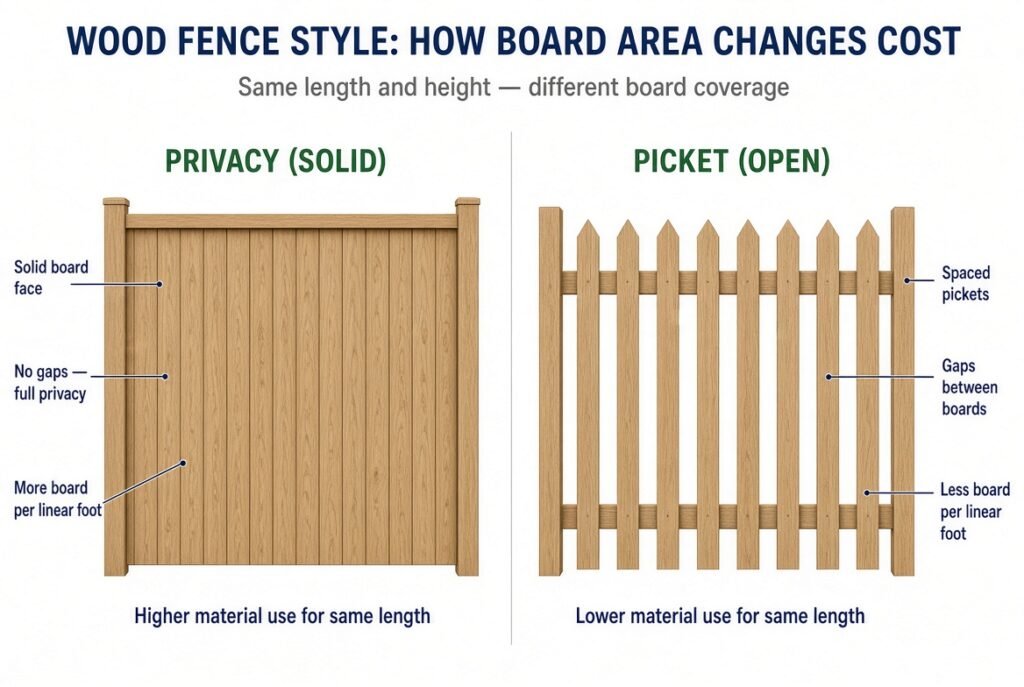
Style changes cost as much as it changes looks. Wood privacy fence cost usually runs higher than open picket for the same length, because privacy uses more board. Wood fence prices also climb with height and species.
- Privacy (solid board or panel): more board area and a higher material cost. Common at 6 feet.
- Picket: less board per foot and often a lower material cost, but it still needs posts and rails.
- Board-on-board: overlapping boards leave fewer gaps and use more lumber than a single layer.
- Horizontal: uses different rail and fastener patterns, and labor can rise on long runs.
- Dog-ear or decorative tops: a small material premium that usually matters less than height and length.
Wood fence vs chain link cost and vs vinyl cost
Chain link vs wood fence cost usually favors chain link on long runs, as long as you don’t need privacy. Wood often wins on privacy and looks, especially if the yard faces neighbors. Vinyl vs wood fence cost depends on panel prices and on whether you count future staining. The gap shifts with height, gates, and local labor, so run both materials at the same length before you decide.
For a look at any fence material, try the main fence cost planner. If chain link is on your list, use the chain link cost per foot calculator.
Lifespan, repair, and maintenance
How long a wood fence lasts depends on the species, ground contact, moisture, and whether you stain or seal it. Many residential wood fences last for decades, but climate and care make a big difference. Poor drainage, wood in constant ground contact, and skipped sealing all shorten that life.
A repair can mean a few boards or a single post. When many posts fail, replacing the run often makes more sense than patching it again and again. Get both prices in writing.
What drives wood fence cost
- Length and height: the two biggest multipliers.
- Wood type: treated pine, cedar, or redwood.
- Style: privacy, picket, board-on-board, or horizontal.
- Posts and depth: frost-line depth and concrete volume matter in cold climates.
- Gates: walk gates and drive gates cost more than a plain section of fence.
- Removal and disposal: tearing out an old fence is often its own line.
- Access and terrain: slope, rock, and tight side yards raise labor.
- Finish: stain or paint, if included, is often an extra per-foot or flat charge.
How to check a contractor quote
Enter the same length, height, and number of gates you gave the contractors. If they share their material and labor assumptions, put those in the rate fields. Then enter the quoted total in the comparison field. A big gap between a bid and your wood fence cost estimate usually points to a different waste allowance, a missing removal line, different post specs, or overhead that never showed up as its own line.
Also ask whether the posts are wood or steel, how deep they go in your frost zone, whether concrete is included, and whether haul-away is in the price. A written scope tells you more than one bottom-line number.
Related calculators
- Fence Cost Calculator — plan any fence material
- Chain Link Fence Cost Calculator — cost per foot, including cyclone
- Roof Replacement Cost Calculator — build a total with your rates
- Roof Square Footage Calculator — measure roof squares only
- Fascia & Soffit Cost Calculator — price by linear foot
External references
For dig safety and industry background:
Frequently asked questions
How much does a wood fence cost?
Most published guides put a 6-foot wood privacy fence in the low thirties to the low fifties per linear foot, installed. Height, wood type, style, and local labor can move that either way. Enter your own rates in the calculator to get a total that matches your quotes.
How much does wood fence cost per foot?
Wood fence cost per foot is usually quoted installed, and material and labor are the two big pieces. Gates, removal, and hard access sit on top. Use the per-foot fields in the calculator so each piece stays visible.
How much does a 6-foot wood fence cost?
Six feet is the most common height for a residential privacy fence. The total depends on length and wood type. Set the height to 6 ft, enter your rates, and add gates if you need them.
What does 100 feet of fence cost?
For wood, multiply your all-in rate by 100, then add gates, removal, and tax. At about $35, $42, and $50 per foot, 100 feet comes to roughly $3,500, $4,200, and $5,000 before extras. Check those figures against local bids.
How much does wood fence installation cost?
Installation cost is mostly labor, posts, concrete, and site conditions. Material is a separate line unless the quote is fully installed. Rocky soil, slopes, and tight access raise labor even when board prices stay flat.
What is the cheapest wood to use?
Pressure-treated pine is usually the lowest-cost wood option at retail, and open picket styles use less board than solid privacy. Still, the cheapest fence on day one isn’t always the cheapest over its life if upkeep or early replacement adds up.
Is chain link cheaper than wood?
Often, yes. Chain link is usually cheaper per foot installed, especially on long runs. Wood privacy usually costs more but blocks the view. Run both at the same length in this calculator and in the chain link calculator.
Is vinyl cheaper than wood?
Usually not on day one. Basic treated wood can cost less than vinyl up front, while vinyl may come out ahead over time if you avoid repeated staining. Local labor and panel prices decide the gap more than any general rule.
How much does a cedar fence cost?
Cedar material and installation usually cost more than basic pressure-treated pine for the same height and length. Enter cedar rates from your supplier and your labor quotes instead of leaving a pine default in place.
How long does a wood fence last?
Lifespan varies a lot with climate, species, and upkeep. Ground contact, poor drainage, and skipped sealing shorten it. Ask local contractors what they see on similar jobs near you.
Does the price include stain or sealer?
Not always. Some quotes cover bare installation only, and others bundle stain. Ask for finishing as its own line so you can compare installation prices fairly.
How much does wood fence repair or replacement cost?
A small repair can mean a few boards or one post, and the price depends on access and matching lumber. Full replacement usually costs more because it adds removal, disposal, new posts, and new boards. Ask for a repair price and a replacement price for the same length, and enter removal as its own line when you compare bids.
Do I need a permit for a fence?
Many cities require a fence permit and set height or setback limits, and the rules are local. Check with your building department before you dig. This calculator can’t tell you whether you need a permit or what it costs.
Is this wood fence cost calculator a final quote?
No. This tool is a planning aid. It uses the rates you type and shows a breakdown you can compare with written bids. A contractor’s takeoff, contract, or inspection still has to come from a licensed professional.
Last reviewed: October 2026
Limits and disclaimer
This wood fence cost calculator is a planning aid. It doesn’t replace a professional takeoff, a written contract, or an on-site inspection. It also can’t confirm code compliance, permit fees, structural strength, or a contractor’s overhead and profit. Before you buy or sign, check product specs, post depth for your frost line, and warranty terms with the supplier and a licensed local contractor. Call 811 before you dig.