
Privacy Fence Cost Calculator
This privacy fence cost calculator uses your own fence length and local rates, so the total cost follows your quotes instead of a national average. How much a privacy fence costs on your lot still depends on length and scope. A low per-foot price can hide gates, tear-out, and haul-away. Here, each of those lines stays on screen, so you can compare bids on equal terms.
Privacy fence calculator and cost estimator
The privacy fence estimated cost ranges between $25 to $55 per linear foot for a solid 6-foot run, based on 2026 guides for wood and vinyl. This not a single number as the height, material, gates, and site work all move it. To use this calculator properly for the privacy fence cost estimation, enter the length and height in feet. Six (06) feet is the most common choice for a backyard. Choose wood or vinyl (whatever you want), then type in your material and labor rates in dollars per linear foot as per your local rates. Gates, waste, removal, tax, and a minimum charge show up in the total when you set them. Turn on post estimating, and posts and concrete get their own lines too. It also works as a privacy fence installation cost calculator: leave the material rate at zero and only the labor line remains.
Measure the run before you start. Walk the real fence line, not the property outline, and add up each straight section. Count every corner and gate opening, because both change the posts and hardware you will pay for.
How this calculator works
The privacy fence calculator multiplies your fence length by the material rate and the labor rate you enter. Waste adds extra length to the material order only, and each gate is priced as its own opening. Removal, access, contingency, tax, and a minimum charge are added in a fixed order, so you can follow every line.
To price, a do-it-yourself job, set labor to zero. The material and gate lines still show what you would pay at the store. The privacy fence calculator doesn’t check your property lines, HOA rules, soil, or frost depth, and it can’t replace a written contractor scope. If you plan to dig, call 811 first.
How the numbers are calculated
These rules match the live fence cost engine on this site. Every total comes from the rates and lengths you type in—not from a locked national average inside the tool.
- Order length (material) = net fence length × (1 + waste%). Waste applies to material only (capped 0–25%).
- Material cost = order length × material rate ($/LF).
- Labor cost = net fence length × labor rate ($/LF). Labor does not use the waste adder.
- Gates = walk-gate count × walk-gate price + drive-gate count × drive-gate price. Gate openings are not subtracted from the fence length; they are separate line items.
- Posts and concrete (optional): when “Estimate posts & footings” is on, post count ≈ max(ceil(length ÷ spacing) + 1, corners), with a floor of 2. Spacing defaults to the material’s on-center value if you leave the field blank. Post $ and concrete $ are multiplied by that count.
- Removal = flat $ + (net length × $/LF).
- Access / terrain = flat $ + a percent of (labor + posts + concrete only).
- Core = material + labor. Subtotal adds gates, posts, concrete, removal, permit, and access.
- Contingency = subtotal × contingency %. Tax applies after contingency. If a minimum job charge is set and the total is still below it, the tool adds the difference as a minimum-charge adjustment.
Height mainly guides the suggested starting rates and the face-area reference line. “Solid / privacy-style” and “sloped yard” are labels only—they do not change the math. Ask your installer about stepped panels or racking on slopes.
Post and gate assumptions
Post count is a planning heuristic, not a field survey. The privacy fence calculator uses your spacing (or the material default—often 8 ft on-center for wood privacy, 10 ft for chain link), then takes the greater of “ceil(length ÷ spacing) + 1” and the corners/ends value you entered. Gate posts are not modeled as extra hardware beyond the gate price lines; if your contractor counts dedicated gate posts, add that cost in the gate or post fields. Concrete is priced per estimated post when that option is on. A site inspection can change spacing, depth below frost line, and corner treatment.
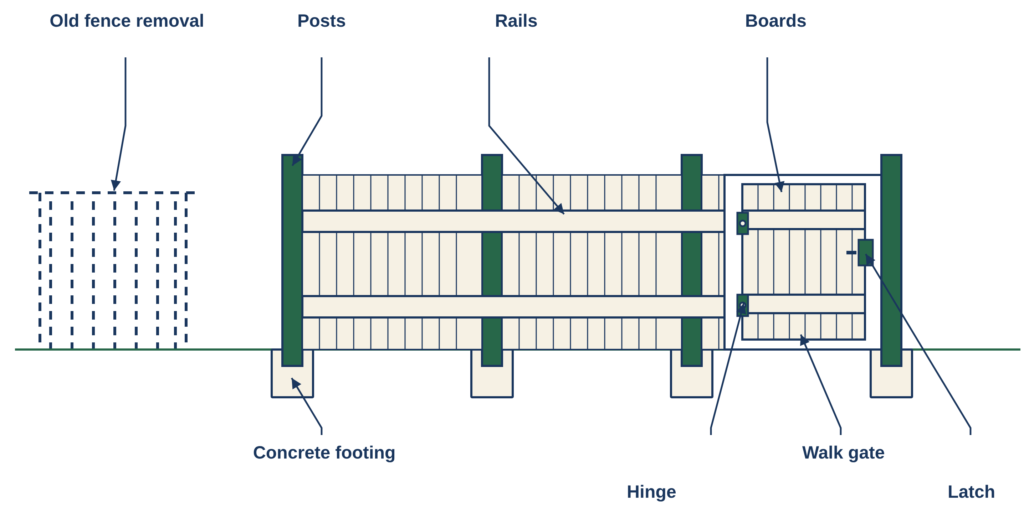
Privacy fence cost per foot
Privacy fence cost usually starts with a per-foot figure, and the per foot is the number most contractors quote first. Quotes are almost always for the installed fence. A typical installed price covers posts, rails, boards or panels, fasteners, concrete, and labor for the main run. Gates, old fence removal, stain or sealer, permits, and brush clearing often get their own lines. Ask which of those your number includes before you compare two bids. Price per foot only means something next to a clear scope.
The privacy fence calculator does not lock in one national rate. Suggested material and labor figures in the tool are editable starting points only. Published 2026 homeowner guides for 6-foot solid wood or vinyl privacy often fall roughly in the mid-twenties to mid-fifties per linear foot installed; slope, rock, and extra gates push bids higher. Use that band only as context when you talk to contractors, then type your local rates into the tool.
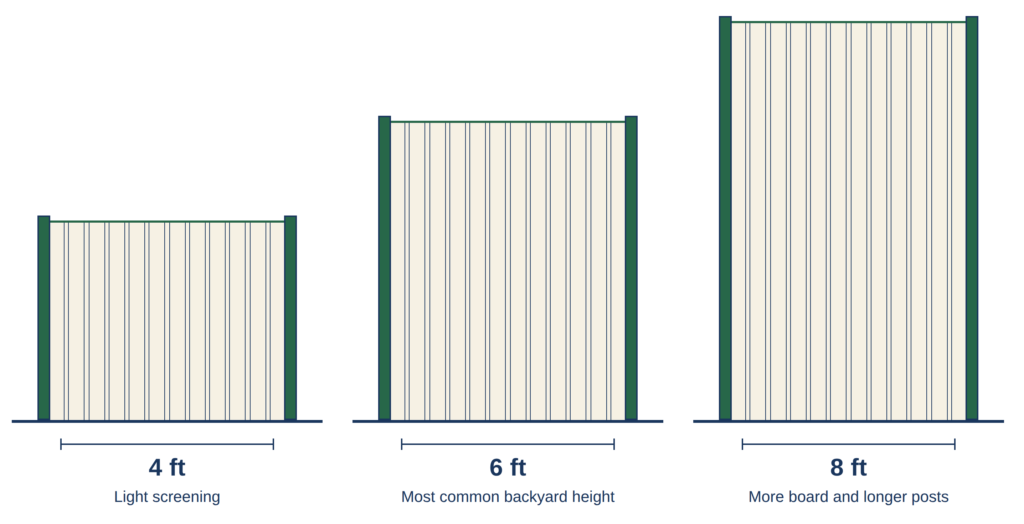
| Height | What changes | Planning note |
|---|---|---|
| 4 ft | Less board and shorter posts, but less screening | Usually below a 6 ft run in the same style |
| 6 ft | The most common backyard height | About $25 to $55 per LF installed in 2026 guides |
| 8 ft | More board, longer posts, deeper holes, and stricter review in some areas | Usually above 6 ft, so ask for quotes at both heights |
How much does a 6-foot privacy fence cost per foot?
Most people who ask this mean a solid 6-foot run in wood or vinyl. Six feet blocks everyday sight lines from neighboring yards, and it is the height most crews quote by default. The cost of a 6 foot privacy fence that you see online is only a starting point, because material and layout change the quote.
Worked example (matches the live tool): Enter 150 ft net length, height 6 ft, waste 10%, material $20/LF, labor $16/LF, and leave gates, posts, removal, tax, and contingency at zero.
- Order length = 150 × 1.10 = 165 LF
- Material = 165 × $20 = $3,300
- Labor = 150 × $16 = $2,400 (on net length only)
- Core (material + labor) = $5,700 → $38.00 per LF core
- All-in total stays $5,700 until you add gates, removal, posts, tax, or a minimum charge
Add one walk gate at $250 and the all-in total becomes $5,950. Turn on post estimating with 8 ft spacing and four corners on a 150 ft run and the tool estimates posts, then multiplies your post $ and concrete $ per post. Always replace the sample rates with figures from your written quotes.
Privacy fence cost for 100, 150, and 200 feet
Length matters as much as the per-foot rate. If you wonder how much 100 feet of privacy fence costs, this table gives a quick sketch before you ask for bids. Use the calculator with your own rates for the real figure.
| Length | At about $30/LF all-in | At about $42/LF all-in | At about $55/LF all-in |
|---|---|---|---|
| 50 LF | ~$1,500 | ~$2,100 | ~$2,750 |
| 100 LF | ~$3,000 | ~$4,200 | ~$5,500 |
| 150 LF | ~$4,500 | ~$6,300 | ~$8,250 |
| 200 LF | ~$6,000 | ~$8,400 | ~$11,000 |
Privacy fence installation cost
Privacy fence installation cost is mostly labor, posts, concrete, and site access. How much it costs to install a privacy fence climbs on sloped, rocky, or root-heavy ground, and every extra gate adds hardware time. Two yards with the same footage can get very different quotes for these reasons.
Ask each contractor to split the bid into material, labor, gates, removal, and haul-away. If a line is missing, ask for it. That way, you can enter each piece in the calculator and see where two bids really differ.
Build cost vs installed cost
If you do the work yourself, the cost to build a privacy fence is mostly materials. An installed quote adds labor. Set labor to zero to see a materials-only number, then put the pro rate back when you compare written bids.
Labor cost to install a privacy fence
Labor covers layout, digging, setting posts, hanging boards or panels, aligning the line, and basic cleanup. A flat, open yard goes faster than a tight side yard full of roots or rock. Use the labor rate from your quotes, not a published average, so the total reflects your market.
Cost to replace a privacy fence
The cost to replace a privacy fence is the new fence plus removal. Tear-out and disposal are often priced per foot or as a flat line, and posts set in concrete take longer to pull. Replacing a whole run usually costs more than patching a few boards, but a failing fence can make repairs a poor deal.
Ask for a repair price and a replacement price for the same length. Enter the removal amount as its own line in the calculator, then compare the two totals side by side.
Cheap and affordable privacy fence options
The cheapest privacy fence is the one that fits your yard without paying for features you don’t need. These choices usually lower the quote the most:
- Keep the style simple: single-layer vertical boards generally use less lumber than board-on-board or decorative layouts.
- Pick the material that fits the budget: pressure-treated pine usually costs less up front than cedar or vinyl, although wood needs stain or sealer later.
- Limit the gates: each gate adds posts, a frame, and hardware.
- Fence only what you need: a shorter run cuts material and labor in direct proportion.
- Compare the same scope: a lower total can mean removal or haul-away was left out.
- Consider a different product for partial screening: chain link with privacy slats costs less in many markets, but it doesn’t look or feel as solid. See the Chain Link Fence Cost Calculator for that math.
Wood vs vinyl privacy fence cost
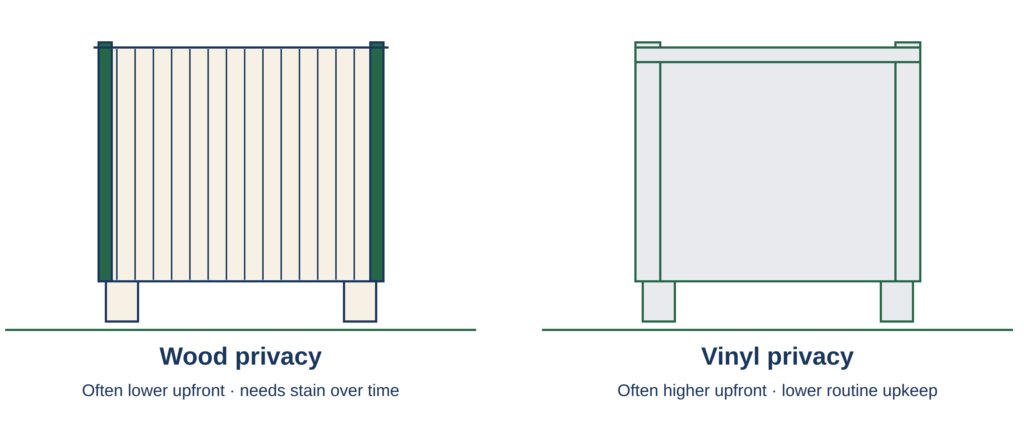
Wood is what many homeowners picture first. Guides for wood privacy fences cluster in the low thirties to low fifties per foot installed, the same planning band used on the Wood Fence Cost Calculator, which goes deeper on cedar, pressure-treated pine, and board styles.
Vinyl privacy fence cost is often higher on day one and lower over time, since vinyl doesn’t need routine staining. Vinyl privacy fence installation cost also depends on the panel style and post system, so enter the installed rate from your own quote. Keep the height and gate count the same when you compare wood and vinyl bids.
Standard height for a backyard fence
Most residential privacy fences are about 6 feet tall. A 4-foot fence gives light screening, and an 8-foot fence blocks more view but needs longer posts and deeper holes. That is why an 8-foot privacy fence usually costs more per foot. Many cities and HOAs set height limits, and front yards often have stricter limits than back yards. Check the rules before you lock in a design.
What drives privacy fence cost
- Length and height: the two biggest multipliers.
- Material: pressure-treated pine, cedar, vinyl, and composite sit in different price classes.
- Style: board-on-board and custom tops add lumber and labor.
- Posts and depth: frost-line depth and concrete volume matter in cold climates.
- Gates: walk and drive gates cost more than a plain section.
- Terrain and soil: slopes need stepped sections, and rock slows digging.
- Access: a narrow side yard or a long carry from the street adds labor time.
- Removal and disposal: tearing out an old fence is often its own line.
- Permits and surveys: local fees and a property survey can add to the budget.
How to compare privacy fence quotes
Enter the same length, height, material, and gate count you gave the contractors. Put their material and labor figures in the rate fields. Then enter the quoted total in the comparison field. A big gap usually points to a different waste allowance, a missing removal line, different post specs, or overhead that never showed up as its own line.
Also ask whether the per-foot price includes concrete, fasteners, and haul-away, and whether stain or sealer is in scope. Matching scope matters more than matching one headline number.
Use the result as a comparison sheet when you review bids. If a bid is much higher, check whether it includes removal, concrete, haul-away, hard digging, permits, a taller height, or a different material grade. If it is much lower, confirm the same scope is in writing before you sign.
What this privacy fence calculator does not include
The planning total is only as complete as the lines you fill in. It does not price:
- Land surveying or property-line disputes
- HOA application fees (permit fee is a separate optional field if you know the amount)
- Underground utility relocation
- Rock excavation, tree or major root removal beyond a simple removal $/LF or flat line
- Engineering stamps or structural redesign
- Specialty gate operators or unusual hardware beyond the gate $ you enter
- Staining, sealing, or long-term finish work
- Financing charges
- Contractor overhead and profit, unless those amounts are already inside the rates you type
Related calculators
For fence cost, wood fence, and chain link, please visit the following pages of ours for details:
- Fence Cost Calculator — plan any fence material
- Wood Fence Cost Calculator — cedar, pressure-treated, and installed cost per foot
- Chain Link Fence Cost Calculator — cost per foot, including cyclone
External references
For dig safety and industry background:
Frequently asked questions
How much does a privacy fence cost?
Most 2026 guides put a 6-foot solid privacy fence at roughly $25 to $55 per linear foot, installed. Height, material, gates, and site work can move that either way. Enter your own rates in the calculator for a total that matches your quotes.
How much does a privacy fence cost per foot?
Privacy fence cost per foot is usually quoted installed, and material and labor are the two big pieces. Gates, removal, and hard access sit on top. Use the per-foot fields in the calculator so each piece stays visible.
What is the average cost of a privacy fence?
No single average fits every yard. Length, height, material, gates, and removal all change the total, so a published average price for a privacy fence is only a starting point. Build your own total from your measured length and quoted rates.
How much does it cost to install a privacy fence?
Installation cost is mostly labor, posts, concrete, and site conditions. Material is a separate line unless the quote is fully installed. Enter labor apart from material so you can see each piece.
What does labor add to the price?
Labor is often quoted per linear foot or folded into an installed per-foot price. Flat open lots take less time than slopes, rock, or tight side yards. Ask your contractor for a labor line you can enter directly.
How much does 100 feet of privacy fence cost?
Multiply your all-in rate by 100, then add gates, removal, and tax. At about $30, $42, and $55 per foot, 100 feet of privacy fence comes to roughly $3,000, $4,200, and $5,500 before extras. Check those figures against local bids.
How much does an 8-foot privacy fence cost?
An 8-foot fence usually costs more per foot than a 6-foot fence, because it needs more board, longer posts, and deeper holes. Local review can also apply. Run both heights with the same rates in the calculator to see the gap.
What is the cheapest privacy fence?
Pressure-treated pine with a simple vertical-board style is often the lowest-cost solid option. Fewer gates and a shorter run help too. The cheapest fence up front isn’t always cheapest over time if upkeep adds up.
How much does it cost to replace a privacy fence?
Replacement costs the new fence plus removal and disposal. Tear-out is often a separate line, and posts set in concrete take longer. Get a repair price and a replacement price for the same length, then compare them.
Does removing an old fence raise the price?
Yes. Tear-out, hauling, and disposal add labor and fees, and posts in concrete take longer. Ask for removal as its own line and enter it in the calculator.
Do gates raise the price?
Yes. Each gate needs extra posts, a frame, hardware, and careful alignment. A drive gate or double gate runs higher than a single walk gate, so plan the openings before you compare bids.
How tall is a privacy fence?
Most residential privacy fences are about 6 feet tall. Four-foot fences screen less, and 8-foot fences block more view and usually cost more. Height limits vary by city and by yard, and front yards often face stricter limits, so check local code and your HOA before you build.
Do I need a permit for a fence?
Many cities require a permit or set height and setback limits, and the rules are local. Check with your building department and HOA before you dig. This calculator can’t tell you whether a permit applies.
How accurate is this privacy fence cost calculator?
It is as accurate as the length and rates you enter. It doesn’t replace an on-site takeoff, a written contract, or a local code review. Use it to organize scope and to check whether a quote lines up with the same assumptions.
Last reviewed: October 2026. Calculator methodology checked against the formulas in the live fence cost tool on this site. If you find an error, use the contact page and include the inputs that produced the result. We update the tool when formulas or assumptions change.
Limits and disclaimer
This privacy fence cost calculator is a planning aid. It doesn’t replace a professional takeoff, a written contract, or an on-site inspection. It also can’t confirm property lines, HOA rules, permits, structural strength, or a contractor’s overhead and profit. Before you buy or sign, check product specs, post depth for your frost line, and warranty terms with the supplier and a licensed local contractor. Call 811 before you dig.